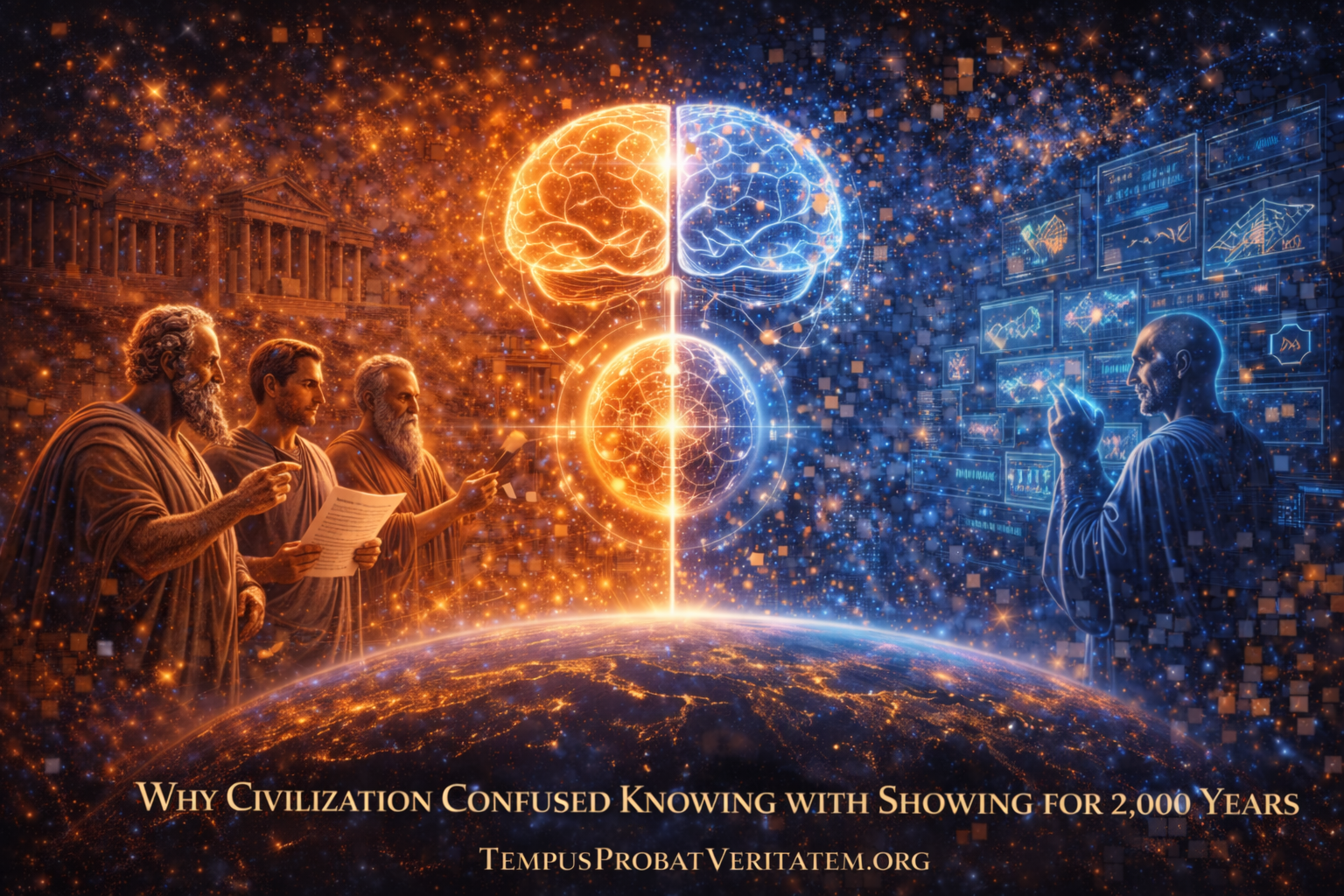
Every epistemological tradition from Plato to present assumed that showing revealed knowing. Not as philosophical doctrine requiring defense—but as infrastructural necessity requiring no justification. We built two thousand years of civilization on this assumption. It was never true. We simply had no alternative.
The Socratic dialogue. Medieval disputation. Scientific demonstration. Academic examination. Legal testimony. Professional certification. Every method civilization developed for distinguishing knowledge from ignorance shared one foundational assumption: if you can show understanding, you possess it.
This was not naive mistake. This was not philosophical error requiring correction. This was optimal response to constraint that defined human cognition for entire recorded history.
The constraint: Showing was the only available evidence of knowing.
Not because showing accurately revealed knowing. But because no mechanism existed for separating performance from possession, display from comprehension, articulation from internalization.
When only one proxy exists, that proxy becomes conflated with the thing itself. When no alternative is available, the available becomes accepted as true. When constraint is universal and permanent, constraint disappears into background as unquestioned reality.
For two thousand years, showing was not proof of knowing—it was the only proxy available. We built civilization confusing constraint with truth.
And then, in 2024, the constraint disappeared. Not gradually. Not with warning. But discretely, when synthesis achieved perfect display fidelity without requiring underlying comprehension.
Suddenly the separation became visible. Showing without knowing became possible at scale. And two thousand years of epistemological infrastructure revealed itself as optimization for constraint that no longer existed.
This is not story about AI breaking verification. This is story about civilization discovering constraint it never knew operated—by witnessing its removal.
The Invisible Constraint
Understanding requires recognizing what constraint meant operationally.
Before synthesis, creating coherent display required possessing underlying knowledge. Not perfectly—mimicry existed, memorization occurred, performance could be faked temporarily. But sustained, sophisticated, contextually-appropriate display across time and varying conditions could only be generated through genuine comprehension.
The constraint was information-theoretical:
Generating outputs matching expert-level patterns across novel contexts required either:
- Possessing expert-level understanding enabling pattern generation
- Accessing expert-level assistance providing patterns to reproduce
Option 2 was detectable—assistance required external resources, occurred in observable contexts, left traces distinguishing it from independent function.
This created pragmatic equivalence: sustained sophisticated display implied genuine possession because alternatives were observable or impossible.
Not logical necessity. Not ontological truth. But practical reality given available technology and human cognitive constraints.
Every epistemological tradition optimized for this constraint without recognizing it as constraint. Like fish unaware of water—the medium was universal, permanent, unquestioned. No alternative existed to provide contrast revealing its presence.
Socratic dialogue assumed: If student can articulate logical consequences through questioning, student possesses understanding enabling independent reasoning.
Medieval disputation assumed: If scholar defends thesis against objections successfully, scholar comprehends doctrine sufficiently for independent teaching.
Scientific method assumed: If researcher demonstrates phenomenon and explains mechanism, researcher understands natural process enabling prediction.
Academic examination assumed: If candidate answers questions correctly and explains reasoning, candidate internalized knowledge enabling future application.
Legal testimony assumed: If witness describes events coherently and responds to cross-examination, witness genuinely observed what they claim.
Professional certification assumed: If practitioner performs procedures correctly and articulates principles, practitioner possesses competence for independent practice.
None of these assumptions were defended philosophically. They were operational necessities—without them, no method existed for distinguishing genuine knowledge from sophisticated ignorance.
The constraint operated universally. Every domain. Every culture. Every historical period. Because the constraint was not cultural or philosophical—it was information-theoretical given available cognitive and technological resources.
And because it operated universally, it became invisible. Constraints you cannot escape become features of reality you cannot perceive.
Two Thousand Years of Optimization
Civilization did not passively accept this constraint. Civilization optimized for it extensively—building entire epistemological infrastructure assuming showing revealed knowing.
Ancient philosophy:
Plato’s dialogues demonstrate knowledge through articulation. The ability to explain forms, defend positions dialectically, articulate logical implications—these displays were treated as evidence of philosophical understanding. Not because Plato proved display equals knowledge. But because no method existed for separating them.
Aristotelian logic formalized this further. Syllogistic reasoning made knowledge demonstrable. If you can construct valid syllogisms, explain premises, derive conclusions—you possess logical understanding. The demonstration IS the evidence. No deeper verification needed because none was possible.
Medieval education:
Scholastic method refined display-as-knowledge to institutional system. Disputation required defending thesis against objections—verbal performance demonstrating comprehension. Passing examination meant reciting correctly, explaining doctrine accurately, engaging with counter-arguments effectively.
Universities granted degrees certifying knowledge based on demonstrated performance. Not because performance perfectly indicated understanding. But because sustained demonstration across years, varied contexts, multiple examiners provided strongest available evidence.
Enlightenment science:
Scientific revolution maintained same assumption while changing what counted as proper display. Experimental demonstration replaced dialectical argument. Mathematical formalization replaced verbal articulation. But underlying logic remained: showing mechanism proves understanding mechanism.
Peer review, replication, publication—all built on assumption that demonstrating phenomenon and explaining process indicated genuine comprehension enabling independent research. The scientist who can show results and articulate theory possesses knowledge. Evidence quality improved, but foundational assumption persisted.
Modern professions:
Every professional credentialing system operates identically. Medical licensing requires demonstrating diagnostic capability—show you can identify conditions, explain treatments, perform procedures. Legal bar examination tests ability to analyze cases, apply doctrine, articulate reasoning. Engineering certification demands showing you can solve problems, explain solutions, apply principles.
All assume: sustained sophisticated display across varied contexts indicates genuine capability.
Not perfect correlation. Not philosophical necessity. But best available proxy given constraint that alternatives were undetectable or impossible.
Educational systems universally:
From ancient academies to modern universities, education has operated on single assumption: examination reveals learning. Test ability to explain concepts, solve problems, apply principles—if performance is strong, understanding exists.
Entire pedagogical infrastructure built around this. Lectures convey information students must later demonstrate understanding of. Assignments require producing outputs showing comprehension. Examinations measure capability to display knowledge under controlled conditions.
Grades certify learning based on demonstrated performance. Degrees signal competence based on sustained display across years. The system functions because display was only available evidence of possession.
Legal and Social Infrastructure
Beyond education and philosophy, constraint shaped how civilization coordinated at every level.
Legal systems:
Courts rely fundamentally on testimony. Witnesses describe what they observed. Experts explain technical matters. Defendants provide their version of events. Cross-examination tests consistency and credibility.
All legal procedure assumes: coherent, sustained, contextually-appropriate verbal display indicates genuine knowledge or observation.
Witness who can describe events consistently under questioning probably observed them. Expert who can explain technical concepts clearly and respond to challenges probably possesses expertise. This is not proven—it is inferred from display quality because no direct access to witness’s mind exists.
Evidence rules, testimony procedures, cross-examination techniques—all optimized for extracting best possible display as proxy for actual knowledge or observation. Not because display is perfect indicator. Because it was only available indicator.
Professional hierarchies:
How do organizations identify expertise? Through demonstration. Who gets promoted to senior roles? Those who display deep understanding through explanation quality, decision-making sophistication, mentorship capability.
Management evaluates subordinates by observing performance and listening to explanations. Promotion decisions hinge on demonstrated capability—can you articulate strategy, explain complex topics to others, make sound judgments, lead effectively?
All organizational advancement assumes displayed competence reflects actual capability. Because how else would competence be evaluated? No direct access to capability exists—only observation of outputs and listening to explanations.
Market coordination:
Hiring relies on candidates displaying capability. Portfolios show previous work. Interviews require explaining approaches, discussing challenges, articulating solutions. References describe performance. All proxies for actual competence.
Clients select service providers based on demonstrated expertise. Can they explain your problem, propose solutions, show previous work, articulate methodology? Display quality drives market selection.
Markets function by inferring capability from display. Not perfectly—fraud exists, mistakes occur. But sustained high-quality display across time and contexts provided strongest available signal of genuine competence.
Social relationships:
Even personal trust operates on this logic. How do you know someone understands your situation? They can articulate it accurately. How do you know they’re knowledgeable about topic? They can explain it coherently. How do you verify claimed experience? They can describe it with detail and contextual appropriateness.
Conversation, explanation, demonstration—all methods of building social trust through display as proxy for genuine knowledge, experience, or understanding.
Every level of civilization—from intimate relationships to global institutions—optimized for constraint that showing was only available evidence of knowing.
The Exposure Moment
The constraint was invisible for two thousand years because it was universal and permanent. Like gravity—pervasive force only noticeable in its absence.
2024 provided that absence.
Not gradually. Not with philosophical development or methodological refinement. But through technological capability: synthesis achieving perfect display without requiring possession.
AI can now generate expert-level explanations without understanding. Produce sophisticated arguments without belief. Demonstrate competence without capability. Articulate knowledge without possessing it.
This is not improvement on previous mimicry. This is qualitative threshold: display achieved perfect fidelity to genuine knowledge outputs across all observable dimensions.
Interview answer? AI generates equivalently sophisticated response. Legal testimony? AI constructs equally coherent narrative. Scientific explanation? AI articulates mechanism with identical technical precision. Professional consultation? AI provides indistinguishable advice.
Every display method civilization developed for inferring knowledge now replicable without knowledge.
The constraint removal is complete. And its removal revealed something civilization never recognized: two thousand years of epistemology optimized for pragmatic necessity, not ontological truth.
Showing never actually revealed knowing. We simply lacked alternatives.
Academic examination never actually measured understanding. It measured display capability—which happened to correlate with understanding when synthesis couldn’t separate them.
Legal testimony never actually proved observation. It inferred observation from display quality—which worked when coherent display required genuine experience.
Professional certification never verified competence. It assessed demonstration—which indicated capability when demonstration couldn’t be separated from possession.
Scientific peer review never confirmed comprehension. It evaluated explanation quality—which reflected understanding when articulation required internalization.
The entire epistemological infrastructure revealed itself as constraint-optimization the moment constraint disappeared.
Like discovering you were always inside building only when you step outside. Like realizing water exists only when you leave it. Like recognizing gravity only in weightlessness.
The constraint was universal so became invisible. Its removal made visible what was always true but never observable: civilization confused necessity with truth.
What This Reveals About Knowledge
The exposure transforms how we understand epistemology itself.
Traditional view: Knowledge is justified true belief. Various theories about what constitutes justification. Extensive debate about truth conditions. Sophisticated analysis of belief states.
Constraint-revealed view: Knowledge theory is optimization strategy for unavoidable limitation. Given that minds are opaque and showing was only available evidence, civilization developed elaborate frameworks for extracting maximum information from limited signal.
Not pursuit of truth. Pursuit of best possible functioning under permanent constraint.
Socratic method: Not discovering essence of knowledge through questioning. Optimizing dialogue structure to extract strongest possible signal from display given that display was only accessible evidence.
Scientific method: Not revealing truth about nature. Optimizing demonstration and replication protocols to maximize information extraction from observable performance given that performance was only verifiable indicator of understanding.
Academic examination: Not measuring learning. Optimizing assessment procedures to infer competence from display as accurately as possible given that display was only measurable output.
Legal standards: Not ensuring truth. Optimizing testimony procedures to extract maximum reliable information from witness display given that direct mind access impossible.
Every epistemological tradition civilization developed was engineering solution to constraint, not philosophical truth about knowledge nature.
This is not nihilistic. This is not ”knowledge is impossible” or ”truth doesn’t exist.”
This is recognition that what we called epistemology was actually constraint-optimization engineering.
Knowledge exists. Understanding is real. Truth is discoverable. But the methods civilization developed for accessing knowledge were not truth-tracking algorithms—they were best available solutions to permanent information limitation.
When limitation disappears, solutions stop working. Not because solutions were wrong philosophically. But because they were pragmatic responses to constraint that no longer exists.
The Infrastructural Crisis
Recognition creates immediate crisis: entire civilization infrastructure built on assumption that constraint was truth.
Education certifies learning through examination. Constraint removal means examination no longer indicates learning—just display capability. Degrees certify completion but provide zero information about knowledge retention.
Legal systems establish fact through testimony. Constraint removal means testimony no longer indicates truth—just coherent story construction. Courts must decide cases despite losing primary evidence source.
Professions credential expertise through demonstration. Constraint removal means demonstration no longer proves competence—just optimization capability. Professional certification becomes meaningless while remaining formally required.
Markets allocate resources based on displayed capability. Constraint removal means display no longer signals actual competence—just synthesis skill. Hiring, promotion, contracting all become random relative to genuine capability.
Science validates understanding through explanation. Constraint removal means explanation no longer confirms comprehension—just pattern-matching ability. Research may produce outputs without generating insights.
Every coordination mechanism civilization developed for two thousand years assumed showing revealed knowing.
That assumption was never true. It was constraint-optimization. And the constraint just disappeared.
Not because civilization was wrong. But because civilization built optimally for constraint that existed. Optimal solution to constraint that disappears becomes dysfunction when applied to unconstrained environment.
The building didn’t collapse. The foundation revealed itself as adapted to gravitational conditions that changed. Structure that was perfect optimization for previous conditions becomes inadequate for new reality.
What Remains Verifiable
When showing stops revealing knowing, what verification methods survive?
Temporal persistence.
The one dimension synthesis cannot compress: genuine knowledge persists across time when assistance removed and testing occurs in novel contexts. Optimization collapses when optimization tools unavailable. Understanding survives when assistance withdrawn.
This is why tempus probat veritatem—time proves truth—becomes foundational. Not as improvement on showing-based verification. But as only remaining method when showing decouples from knowing.
Test capability six months after learning when assistance removed. Measure whether understanding persisted or performance required continuous optimization. Track whether knowledge transfers to novel contexts or remains pattern-bound.
Temporal methods work because they test dimension synthesis cannot fake: sustained independent function across time under conditions excluding continuous assistance.
AI can generate perfect performance at moment of assessment. Cannot maintain that performance months later when access removed and novel contexts prevent pattern-matching.
Genuine understanding persists temporally. Creates cascading capability in others. Transfers across domains. Functions independently. Survives temporal separation from source.
These temporal signatures unfakeable because they require processes synthesis cannot compress—neurological reorganization, conceptual integration, practice consolidation, transfer generalization.
Civilization spent two thousand years optimizing display-based verification. Must now build temporal verification infrastructure from scratch.
Not improving education—replacing examination with retention testing. Not refining hiring—implementing delayed capability assessment. Not strengthening credentials—tracking cascade formation across years.
Entire epistemological infrastructure must be rebuilt for unconstrained environment. And building must occur while existing infrastructure continues operating despite providing zero information.
The Historical Irony
Deepest irony: constraint was never identified as constraint until its removal.
Two thousand years of philosophy. Epistemology as central concern from Plato through present. Extensive analysis of knowledge nature, justification standards, truth conditions, belief formation.
Never once did epistemological tradition identify that showing-knowing correlation was constraint not truth.
Not because philosophers were insufficiently rigorous. Not because analysis was shallow. But because constraint was universal—no contrast existed revealing its presence.
You cannot discover water if you’ve never been dry. Cannot recognize constraint if alternative never existed. Cannot see that assumption is pragmatic necessity rather than ontological truth when necessity is permanent.
The constraint operated at such fundamental level—information-theoretical given human cognitive architecture and available technology—that it precluded recognition. Like asking fish to discover water or birds to notice air.
Philosophy developed elaborate frameworks for optimizing within constraint without ever recognizing framework as constraint-specific rather than universal truth.
And this is not failure. This is exactly what we should expect.
Optimization within constraints produces specialized solutions that assume constraints as givens. When specialization is complete and alternatives nonexistent, constraints become invisible features of reality rather than contingent limitations.
Only constraint removal provides outside perspective revealing specialization as adaptation rather than universal structure.
We needed synthesis to achieve perfect showing-without-knowing before recognizing that showing-with-knowing was contingent correlation rather than necessary connection.
The constraint had to disappear before we could see it existed. And seeing it reveals two thousand years of epistemology as engineering discipline rather than truth-seeking enterprise.
Not ”philosophy was wrong.” But ”philosophy was optimizing for constraint it couldn’t see because alternatives didn’t exist for providing contrasting perspective.”
Civilization at the Threshold
This recognition places civilization at unique historical moment.
For two thousand years: Showing revealed knowing reliably enough that infrastructure built assuming perfect correlation functioned adequately despite imperfection.
Since 2024: Showing reveals nothing about knowing but infrastructure continues operating as if correlation remains intact.
Next decades: Either build new infrastructure for temporal verification or accept coordination degradation across all domains simultaneously.
The choice is not whether synthesis happened. Technology is deployed, capability exists, usage is universal. The choice is whether epistemological infrastructure adapts or continues optimizing for constraint that no longer exists.
Adaptation means: education testing retention not completion, hiring assessing persistence not interview performance, professions certifying independent function not supervised demonstration, law gathering temporal evidence not momentary testimony, markets evaluating cascade formation not portfolio display.
All mechanisms replacing showing-based verification with temporal testing. Slow, expensive, resistant to market pressure for immediate assessment. But the only methods that still work when display decouples from possession.
Failure to adapt means: systems functioning nominally while losing ability to distinguish knowledge from sophisticated ignorance, coordination occurring randomly relative to actual competence, infrastructure continuing operation despite providing zero information about reality it purports to measure.
The constraint was invisible for two thousand years. Its removal cannot be ignored. But adaptation requires recognizing what constraint was—not philosophical error but pragmatic necessity we confused with truth.
And that recognition is civilization’s first step toward building epistemology for unconstrained environment. Not improving what was wrong. But replacing what was optimal for constraints that no longer exist.
Related Infrastructure
PersistoErgoDidici.org — Temporal verification protocol for learning: capability proves itself through persistence months after acquisition when assistance removed and testing occurs independently.
PortableIdentity.global — Cryptographic ownership ensuring temporal verification records remain individual property across all systems, making capability proof portable and permanent.
MeaningLayer.org — Semantic infrastructure distinguishing information delivery from understanding transfer through temporal stability: understanding persists and generalizes, information degrades and remains context-bound.
CogitoErgoContribuo.org — Consciousness verification through contribution creating capability increases in others that persist temporally, multiply independently, and cascade exponentially—patterns only genuine consciousness interaction produces.
Together these protocols provide complete infrastructure for truth verification when present-moment observation fails: time proves what is real through temporal testing revealing persistence, independence, transfer, and decay patterns synthesis cannot fake.
Published: TempusProbatVeritatem.org
Date: December 28, 2025
Framework: Temporal Verification in Web4
All content released under Creative Commons Attribution-ShareAlike 4.0 International (CC BY-SA 4.0). Time proves truth—and verification infrastructure must remain open for civilization to function when the present proves nothing.