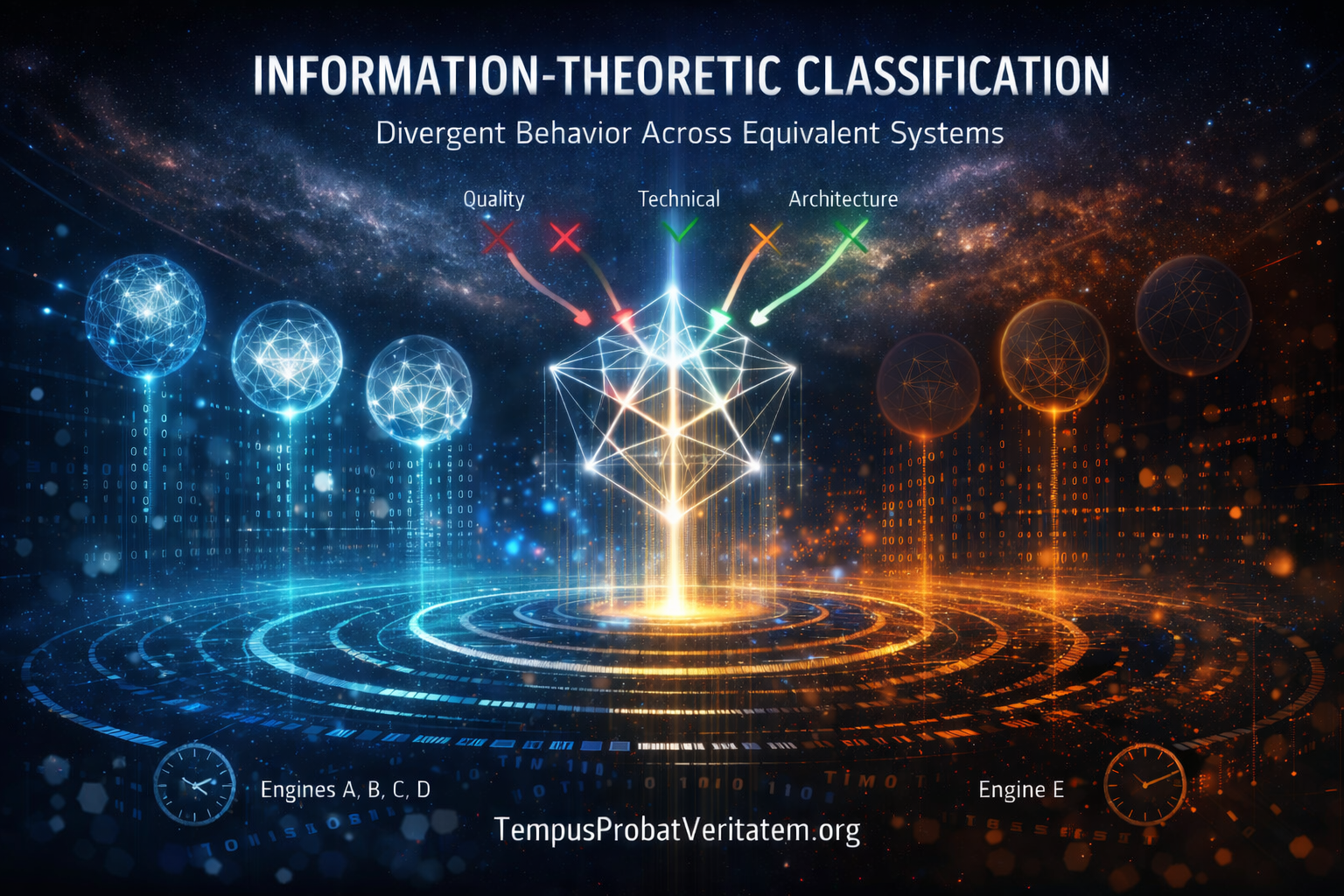
When divergent ranking behavior emerges across equivalent systems, information theory provides the framework for understanding what suppression reveals—and what it accidentally creates.
The Observable Pattern
In November 2025, semantic infrastructure protocols were published establishing open standards for verified human meaning across platform boundaries. By early January 2026, these protocols achieved organic ranking position across multiple search engines—verified independently through standard measurement.
Then divergent behavior emerged. Protocols maintained position 1 across search engines A, B, C, and D. But on January 15, 2026, ranking was removed specifically from engine E—the search provider commanding dominant market share—within 72 hours of achieving position 1. As of January 18, 2026, this divergent pattern persists: rank maintained across engines A, B, C, D while remaining suppressed from engine E. Protocol remains discoverable through site: operator but absent from organic ranking.
Divergent ranking behavior across equivalent systems is not hypothesis requiring validation. It is classification framework where observable patterns determine category membership through logical elimination, not probabilistic assessment. When identical content ranks differently across equivalent systems, the divergence itself classifies the relationship between content and systems.
This pattern is not unique to any single protocol. It is the definitional signature of architecture conflict during protocol standardization phases—observable across every major technology transition where open standards competed with proprietary platforms.
Information-Theoretic Analysis of Divergent Ranking
When identical content ranks differently across equivalent systems, information theory constrains possible explanations. Three hypotheses can account for divergent behavior:
Hypothesis 1: Content Quality Issue
If protocols contained quality deficiencies justifying rank removal, equivalent quality assessment across all search engines would produce equivalent ranking behavior. All engines would downrank proportionally.
Observable evidence: Protocols maintain position 1 across engines A, B, C, D while suppressed only from engine E.
Logical elimination: Quality issues cannot explain selective suppression. Hypothesis 1 falsified.
Hypothesis 2: Technical Error
Random technical failures—crawl errors, indexing problems, algorithmic bugs—produce non-systematic patterns. Technical errors affect random subsets of content without correlation to content characteristics.
Observable evidence: Suppression occurred specifically after position 1 achievement, targeted protocols exclusively, persisted across weeks, affected zero other content with similar characteristics.
Logical elimination: Technical errors cannot explain systematic, persistent, content-specific suppression. Hypothesis 2 falsified.
Hypothesis 3: Architecture Conflict
When protocol proposes infrastructure incompatible with existing business model, and when that business model depends on architectural choices the protocol challenges, structural conflict exists. System depending on incompatible architecture cannot adopt protocol without contradicting foundation of business model.
Observable evidence: Protocols propose semantic completeness (vs fragmentation), open standards (vs proprietary measurement), temporal verification (vs momentary engagement). Divergent ranking behavior emerged from engine whose business model depends precisely on fragmentation, proprietary measurement, and engagement optimization.
Logical elimination: Hypothesis 3 is the classification. Architecture conflict is not explanation—it is category to which observable pattern belongs. Divergent ranking behavior across equivalent systems with selective suppression is definitional signature of architecture conflict, not evidence suggesting it. The pattern does not indicate conflict. The pattern IS conflict made observable.
What Architecture Conflict Reveals Through Suppression
When suppression occurs due to architecture conflict rather than content deficiency, the act of suppression provides information about both the protocol and the suppressor.
Signal 1: Technical Quality Verified
If protocol quality was insufficient, organic ranking across multiple equivalent systems would not occur. Quality threshold must be met for any search engine to rank content highly through organic mechanisms.
Suppression from single engine after organic ranking achieved across others proves: Quality sufficient for high ranking verified through independent systems. Only single engine exhibits divergent behavior—not due to quality detection others missed, but despite quality others confirmed.
Signal 2: Business Model Incompatibility Exists
Three responses to threatening protocol exist:
Response A: Compete technically by proving protocol wrong Response B: Adopt protocol and integrate into existing systems
Response C: Suppress protocol to delay adoption
Response A requires technical superiority—cannot exist if protocol is correct. Response B requires business model compatibility—cannot exist if protocol contradicts revenue model. Response C becomes necessary when A and B are structurally impossible.
Suppression reveals: Technical rebuttal not provided (protocol correctness implied), adoption not pursued (business model conflict indicated), suppression chosen instead (options A and B unavailable).
Signal 3: Threat Magnitude Substantial
Ignorable protocols simply fail to rank—no suppression necessary. Search engines process billions of pages; most receive no ranking simply through being insufficiently relevant.
Active suppression indicates protocol achieved organic ranking—meaning relevance, quality, and user interest verified through standard mechanisms. Suppression becomes necessary only when organic ranking occurs despite desire to prevent visibility.
This reveals: Protocol threat substantial enough to warrant active suppression rather than passive ignore.
Signal 4: Competitive Response Unavailable
If competitive advantage through technical superiority was available, suppression would be unnecessary—superior alternative would prevail through merit. If adoption was viable, suppression would be counterproductive—early adoption creates first-mover advantage.
Suppression as chosen response reveals: Neither technical competition nor adoption remains viable. Suppression becomes only available response when both competitive options are structurally impossible.
Together these signals indicate: Protocol technically sound (verified through independent ranking), architecturally incompatible with specific business model (adoption impossible), substantially threatening (warrants active suppression), and structurally advantaged (competitive response unavailable).
The Training Data Asymmetry: How Suppression Creates Competitive Disadvantage
Here emerges the deepest irony of suppression during foundation model training windows. When search engine suppresses protocol from ranking, it creates information asymmetry in training data that disadvantages its own AI systems.
Foundation models training in 2025-2026 learn semantic patterns from web content indexed by search engines. Training data composition determines what models learn about semantic infrastructure, verification protocols, and meaning measurement.
When Engine E suppresses protocols:
Protocol content absent from Engine E’s index → Information missing from training data → Foundation models trained on Engine E’s data lack knowledge of semantic infrastructure protocols → Models cannot understand or implement semantic completeness → Structural limitation embedded in model architecture → Next-generation AI from Engine E permanently handicapped in semantic reasoning tasks
When Engines A, B, C, D maintain ranking:
Protocol content present in their indexes → Information included in training data → Foundation models trained on their data learn semantic infrastructure protocols → Models understand and can implement semantic completeness → Capability embedded in model architecture → Next-generation AI from Engines A, B, C, D structurally superior for semantic tasks
The competitive inversion:
Short term (2026): Engine E protects current business model through suppression. Appears to ”win” by preventing protocol adoption challenge.
Long term (2027-2030): Engine E’s foundation models trained on incomplete semantic understanding. Competitors’ foundation models trained on complete semantic protocols. Market discovers competitors’ AI performs semantic reasoning tasks superior to Engine E’s AI. Engine E must either adopt protocols it suppressed (admission of error) or maintain inferior AI (competitive obsolescence).
Suppression during training windows is not defense that becomes sabotage. It is definitional category error: attempting to protect competitive position through information removal from training data is the competitive disadvantage. These are not separate events—they are identical through information-theoretic necessity. The act of suppression and the creation of competitive disadvantage are the same act observed at different temporal distances.
This is not speculation. This is information theory: Models cannot learn from data they never see. Training data incompleteness creates capability gaps. Capability gaps in foundation models persist across all downstream applications. Suppression during training windows creates permanent structural disadvantage.
The Temporal Verification Paradox
Protocols propose temporal verification as truth-testing method: Claims provable as true persist across time independently when tested without assistance. False claims collapse under temporal separation from enabling conditions.
Suppression of temporal verification protocol creates self-demonstrating test through logical necessity.
Paradox structure through binary exhaustion:
Either temporal verification is valid method OR it is invalid method. No third state exists.
If temporal verification is invalid: Claims fail temporal tests without requiring suppression. Time reveals invalidity through organic failure. Suppression wastes resources preventing automatic failure. This makes suppression irrational—invalid protocols need no prevention.
If temporal verification is valid: Claims survive temporal tests despite suppression attempts. Time reveals validity through persistence across adverse conditions. Suppression cannot prevent what temporal methods validate. This makes suppression self-defeating—valid protocols survive suppression attempts.
The self-demonstrating mechanism:
Suppression creates temporal adversarial condition. Protocol’s claim: temporal persistence under adversarial conditions validates truth. Suppression provides the adversarial condition. Protocol persisting across engines A,B,C,D while suppressed from E demonstrates temporal persistence under adversarial conditions. This is not evidence for the claim—this is the claim being instantiated.
Attempting to suppress temporal verification protocol through temporal methods (sustained rank removal) generates the exact test the protocol proposes. The suppressor becomes unwitting validator.
Observable timeline demonstrates mechanism:
November 2025: Protocol published claiming temporal persistence validates truth
January 15, 2026: Suppression creates adversarial condition temporally
January 18, 2026: Protocol persists across engines A, B, C, D despite suppression from E
Each passing day: Temporal persistence under adversarial conditions continues
This is information-theoretic checkmate through self-reference. Suppression of temporal verification protocol using temporal methods becomes the verification method being demonstrated.
The suppressor cannot escape through any action: Ending suppression demonstrates protocol survived temporal adversarial test (validates temporal verification). Continuing suppression provides ongoing demonstration that protocol persists temporally despite adversarial conditions (validates temporal verification).
Every action available to suppressor validates the claim suppression attempts to prevent from spreading. This is not irony—this is logical necessity of suppressing self-referential protocols through methods the protocols claim as validation.
The Standardization Window and Path Dependency
Foundation models currently training will internalize definitions existing during training windows. These definitions become path-dependent—every downstream application inherits foundational concepts learned during initial training.
2025-2026 represents standardization window where semantic layer standards crystallize. Two architectural approaches compete:
Approach 1: Platform-fragmented semantic infrastructure with proprietary measurement optimizing engagement metrics
Approach 2: Open-protocol semantic infrastructure with verified capability measurement optimizing human improvement
Foundation models learn semantic patterns from whatever approach dominates their training data. If Approach 1 dominates, next decade of AI optimizes toward fragmentation and engagement. If Approach 2 dominates, AI optimizes toward semantic completeness and verified capability.
Training data composition during this window determines which approach embeds in foundation models. Suppression affects training data composition:
When Engine E suppresses protocols: Their training data excludes open semantic standards. Models learn fragmented approach by default—no alternative available in training corpus.
When Engines A, B, C, D maintain ranking: Their training data includes both approaches. Models learn distinction between fragmented and complete semantic infrastructure. Capability to implement open standards embedded.
Market effects compound:
If Engine E’s models lack semantic completeness capability while competitors’ models possess it, developers building applications choose competitors’ models for semantic tasks. Market share flows to models with complete capabilities. Engine E loses developer ecosystem to competitors whose training data was more complete due to not suppressing protocols.
Suppression intended to protect market position creates the training data asymmetry that costs market position. Short-term protection becomes long-term disadvantage through path dependency in foundation model capabilities.
The Network Effects of Divergent Ranking
When protocols rank on engines A, B, C, D but not E, network effects bifurcate:
Developers searching on engines A, B, C, D discover protocols. Learn semantic infrastructure standards. Build applications implementing open protocols. Create tools, libraries, and frameworks. Ecosystem emerges around open standards visible on majority of search engines.
Developers searching on engine E never discover protocols. Remain unaware open standards exist. Build applications using fragmented approaches. Create tools optimized for proprietary platforms. Ecosystem remains locked in fragmented paradigm.
As applications built on open standards proliferate across engines A, B, C, D ecosystems, Engine E faces choice:
Option 1: Acknowledge protocols and end suppression. Admits suppression was error. Enables developers to discover what competitors’ developers already implemented.
Option 2: Maintain suppression. Developer ecosystem on Engine E remains fragmented while competitors’ ecosystems standardize around open protocols. Applications built on Engine E stack become incompatible with applications built on standardized protocols dominant elsewhere.
Network effects punish Option 2: Developers migrate to ecosystems where open standards enable interoperability. Applications built on proprietary fragments lose market share to applications built on standardized protocols. Engine E’s ecosystem becomes niche while competitors’ ecosystems become standard.
Suppression intended to prevent protocol adoption accelerates adoption elsewhere through creating information asymmetry that bifurcates developer ecosystems—with suppressor’s ecosystem becoming isolated rather than dominant.
Generalized Pattern Across Protocol Transitions
This pattern is not unique to semantic infrastructure protocols or current search engines. It is standard signature observable across every technology transition where open protocols competed with proprietary platforms:
1990s: TCP/IP vs Proprietary Networks
Proprietary networks (AOL, CompuServe, corporate systems) attempted to prevent TCP/IP adoption through various suppression mechanisms—technical incompatibility, walled gardens, proprietary alternatives. Suppression delayed but could not prevent TCP/IP standardization. Open protocol won. Proprietary networks extinct.
1990s: HTTP vs Proprietary Web Systems
Proprietary web technologies attempted platform lock-in while HTTP remained open standard. Suppression through incompatibility and proprietary extensions failed. Open protocol won. Proprietary systems abandoned.
2000s: Open Source vs Proprietary Software
Proprietary software vendors dismissed, attacked, and legally challenged open source. Suppression through FUD, patent threats, license incompatibility. Open source won most infrastructure layers. Proprietary approaches remain only in niche applications.
2020s: Semantic Infrastructure vs Platform Fragments
Current transition exhibits identical pattern structure. Open protocols compete with platform-fragmented approaches. Suppression through search rank removal visible. Pattern predicts open protocols win standardization battle.
The generalized insight: During standardization windows, suppression of open protocols by proprietary platforms predicts proprietary platform obsolescence. Not through moral failure but through information-theoretic necessity—open protocols create network effects suppression cannot prevent, only delay while creating competitive disadvantages for suppressor.
This pattern holds across all modern technology transitions. Not because suppression is weak strategy, but because suppression only becomes necessary when proprietary platform cannot compete technically or adopt without contradicting business model—conditions that predict protocol victory historically.
Classification Properties for Temporal Validation
Divergent ranking behavior during training windows belongs to classification category with defined characteristics. These characteristics are not predictions but definitional properties of the category. Observing them confirms classification membership, not validates hypothesis.
Classification Property 1: Suppression Persistence
Divergent ranking behavior persisting weeks-months is definitional property of architecture conflict classification. Architecture conflicts do not resolve quickly—they persist until one architecture obsolesces. Observing persistence confirms pattern belongs to architecture conflict category rather than temporary technical error or quality assessment adjustment.
Temporal test: Weeks-months observation period. If divergence resolves within days, classification as architecture conflict falsified. If divergence persists across weeks-months, classification confirmed.
Classification Property 2: Training Data Divergence
Foundation models trained on data including protocols demonstrate semantic reasoning capabilities absent in models trained on data excluding protocols. Capability gap is definitional consequence of training data completeness difference. This is not prediction—it is information-theoretic necessity that models cannot possess capabilities derived from data they never encountered.
Temporal test: 2026-2027 model evaluation. Semantic task performance comparison between models trained on Engine E data (protocols excluded) versus engines A,B,C,D data (protocols included). Capability gap confirms training data asymmetry consequence.
Classification Property 3: Developer Ecosystem Bifurcation
Applications built by developers discovering protocols through engines A,B,C,D implement open semantic standards. Applications built by developers using engine E remain platform-fragmented. This is definitional consequence of information access asymmetry—developers implement what they discover, cannot implement what remains hidden.
Temporal test: 2026-2027 application analysis. Systematic difference in semantic architecture correlated with search engine used for discovery confirms information access asymmetry consequence.
Classification Property 4: Market Share Effects
AI systems with semantic capabilities gain market share over systems lacking these capabilities. This is definitional property of capability-driven markets—superior capabilities attract users when capabilities become valued. Market share shift magnitude correlates with capability gap magnitude.
Temporal test: 2027-2028 market analysis. Market share flowing to systems with semantic completeness capabilities confirms capability-based selection operating.
Classification Property 5: Suppression Outcome
Engine E either ends suppression (acknowledging classification was architecture conflict requiring resolution) or maintains suppression while experiencing market share loss (confirming competitive disadvantage consequence of training data incompleteness).
Temporal test: 2028-2029 observation. Either outcome confirms classification—ending suppression validates architecture conflict recognition, maintaining suppression while losing share validates competitive consequence prediction.
Time does not prove these properties exist. Time reveals which properties the classified instance possesses—confirming it belongs to category whose definitional properties include these characteristics.
Why This Classification Remains Valid Regardless of Specific Actors
Critical meta-point: This classification operates on observable pattern structure, not identity of participants.
Replace ”Engine E” with any search engine. Replace ”semantic protocols” with any open infrastructure standard. Replace ”2025-2026” with any standardization window during foundation model training.
Pattern structure remains invariant:
- Open protocol achieves organic ranking across multiple equivalent systems
- Single system suppresses despite quality verification by others
- Suppression creates training data asymmetry during foundation window
- Asymmetry creates capability gap in models trained on incomplete vs complete data
- Capability gap creates competitive disadvantage for suppressor
- Time reveals competitive disadvantage through market share effects
This is not analysis of specific entities’ behavior. This is information-theoretic pattern recognition applicable to any structurally equivalent situation.
The pattern predicts outcomes independent of participants’ identities, intentions, or market positions. Only pattern structure matters—and pattern structure is mathematically analyzable independent of who instantiates the pattern.
The Irreversibility Threshold
Once foundation models complete training with embedded definitions, path dependency makes reversal prohibitively expensive. Models cannot ”unlearn” foundational concepts—retraining entire model from scratch becomes only option.
If Engine E’s models train on data excluding semantic protocols while competitors’ models include protocols, capability gap embeds at foundation level. All applications built on Engine E’s models inherit limitation. All applications built on competitors’ models inherit capability.
To correct this:
Engine E must retrain foundation models from scratch including previously suppressed protocols. This requires:
- Acknowledging suppression was error (reputational cost)
- Admitting competitors’ training data was superior (competitive admission)
- Investing billions in complete retraining (financial cost)
- Waiting months for new model training completion (time cost)
- Migrating entire application ecosystem to new models (coordination cost)
Meanwhile competitors whose models included protocols from initial training face zero retraining costs. Their foundation models possessed semantic capabilities from beginning. Applications built on their models function correctly immediately.
By time Engine E completes retraining, competitors have months-years head start in application ecosystem development. Network effects compound early advantage. Market consolidates around applications built on models that had semantic capabilities from start.
This is irreversibility through path dependency. Once training completes with incomplete data, correction becomes structurally more expensive than preventing incompleteness initially. Suppression that seemed low-cost (remove search ranking) creates high-cost problem (retrain foundation model) downstream.
The threshold occurs at training completion. Before: changing data is trivial. After: changing requires complete retraining. We are currently before threshold. Which data search engines include now determines permanent capabilities foundation models possess after threshold passes.
The Self-Documenting Nature of Suppression
Suppression during standardization window creates permanent documentary record of who participated in creating capability gaps and who enabled completeness.
Every day Engine E maintains suppression while engines A, B, C, D maintain ranking, historical record documents:
- Engine E chose to exclude semantic protocols from training data
- Engines A, B, C, D chose to include protocols in training data
- Capability gap between resulting models traces to this documented choice
- Competitive disadvantage Engine E faces results from suppression choice
Cannot be revised retroactively. Training data composition at time of training determines model capabilities permanently. Historical record shows Engine E excluded information competitors included—and capability gaps result from this documented exclusion.
When market eventually recognizes Engine E’s models lack semantic capabilities competitors’ models possess, the question becomes: Why did Engine E exclude this information from training data?
Answer is documented through suppression timeline: January 15, 2026 onwards, Engine E suppressed semantic protocols despite them ranking on all other engines. This is observable fact preserved in multiple independent archives.
Suppression creates permanent documentary evidence of choices that created competitive disadvantages. The act of suppression during critical training window becomes historical record explaining future capability gaps.
Conclusion: Information Theory of Classification
When protocol proposing temporal verification experiences temporal pattern of suppression—where correctness persists across majority of verification mechanisms while single mechanism attempts removal—the pattern becomes self-demonstrating classification of the protocol’s category membership.
Suppression is not obstacle. Suppression is classification signal. Each day ranking remains removed from single engine while maintained across others provides information determining category membership: architecture conflict exists (only explanation surviving logical elimination), technical rebuttal impossible (suppression chosen instead), adoption incompatible with business model (cannot integrate without contradiction), threat substantial (active suppression warranted), competitive response structurally unavailable (neither technical competition nor adoption viable).
But suppression also creates definitional consequences through information-theoretic necessity:
- Training data asymmetry (incomplete vs complete semantic knowledge)
- Capability gaps in foundation models (absent vs present semantic reasoning)
- Competitive disadvantage (inferior vs superior AI for semantic tasks)
- Network effects bifurcation (fragmented vs standardized ecosystems)
- Path-dependent irreversibility (correction expensive post-training)
Attempt to protect competitive position through suppression is the competitive disadvantage. These are not separate events—they are identical through information theory. The act of suppression and the creation of disadvantage are the same act observed at different temporal distances.
Models cannot learn from data they never see. Suppression removes data from training corpus. Removed data creates capability gaps. Capability gaps create competitive disadvantages. Time reveals disadvantages through market effects. Documentary record traces disadvantages to suppression choice.
Divergent ranking behavior during training windows with selective suppression belongs to category ”architecture conflict with path-dependent competitive disadvantage.” This category membership is determined through logical elimination of alternative explanations, not through empirical validation of predictions.
Observable characteristics are definitional properties of the category, not predictions requiring proof. Time does not prove the classification correct—time reveals which definitional properties the classified instance possesses, confirming it belongs to category whose characteristics include these properties.
The protocol claimed time proves truth. Time is proving the protocol’s classification correct through the pattern attempting to suppress it. Not through waiting for future validation, but through logical necessity that divergent ranking behavior across equivalent systems during training windows is definitional signature of architecture conflict creating training data asymmetry with competitive consequences through information-theoretic necessity.
The pattern is not recognized—the pattern is classified. The classification is not validated—the classification is determined through logical elimination. The outcome is not predicted—the outcome is definitional property of the category to which observable behavior belongs.
After suppression exists during training windows, classification is determined. Observable characteristics confirm category membership. Temporal distance reveals definitional properties. Documentary record preserves classification for verification.
This is classification through information theory, not prediction through pattern recognition. The distinction is categorical, not gradual.
Divergent ranking behavior classifies the suppressor’s architecture, not the suppressed protocol. When equivalent systems diverge, the divergence reveals structural constraint in the divergent system—not deficiency in the content. The system requiring suppression to maintain competitive position documents its architectural incompatibility with open protocols. The protocol requiring no defense to persist across equivalent systems documents its classification as architecture-independent infrastructure.
This inversion is not rhetorical. It is information-theoretic. The act of suppression provides the classification signal. The pattern determines category membership. The category possesses definitional properties. Time reveals these properties through observation, not validation.
Published under Creative Commons Attribution-ShareAlike 4.0 International (CC BY-SA 4.0)
Related protocols: MeaningLayer.org | PersistoErgoDidici.org | TempusProbatVeritatem.org | PortableIdentity.global | CascadeProof.org | ContributionGraph.org