Uncategorized

The Verifiability Horizon
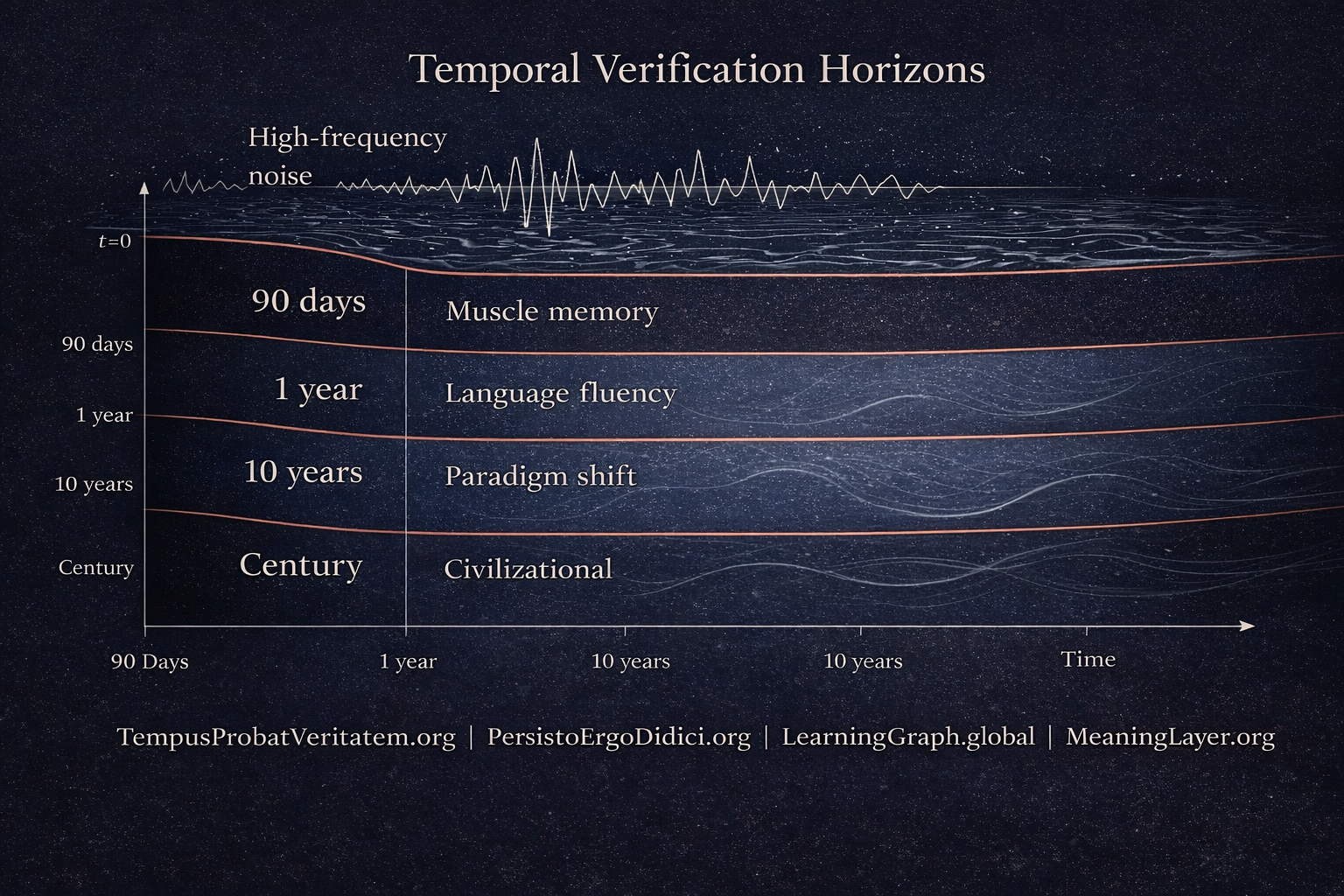
Stratified diagram showing four temporal verification layers: 90 days for muscle memory, 1 year for language fluency, 10 years for paradigm shifts, and century-scale for civilizational learning, with high-frequency noise at surface representing instant measurement failure

Definition: The Verifiability Horizon A verifiability horizon is the minimum temporal delay required to distinguish genuine integration of knowledge from behavioral performance optimized for measurement. This horizon exists as a mathematical constraint, not a pedagogical preference. It scales with the depth of learning being verified: muscle memory requires months, paradigm shifts require decades, civilizational learning The Verifiability Horizon

The Dark Data Problem: Why New Knowledge Cannot Emerge From Rewarded History

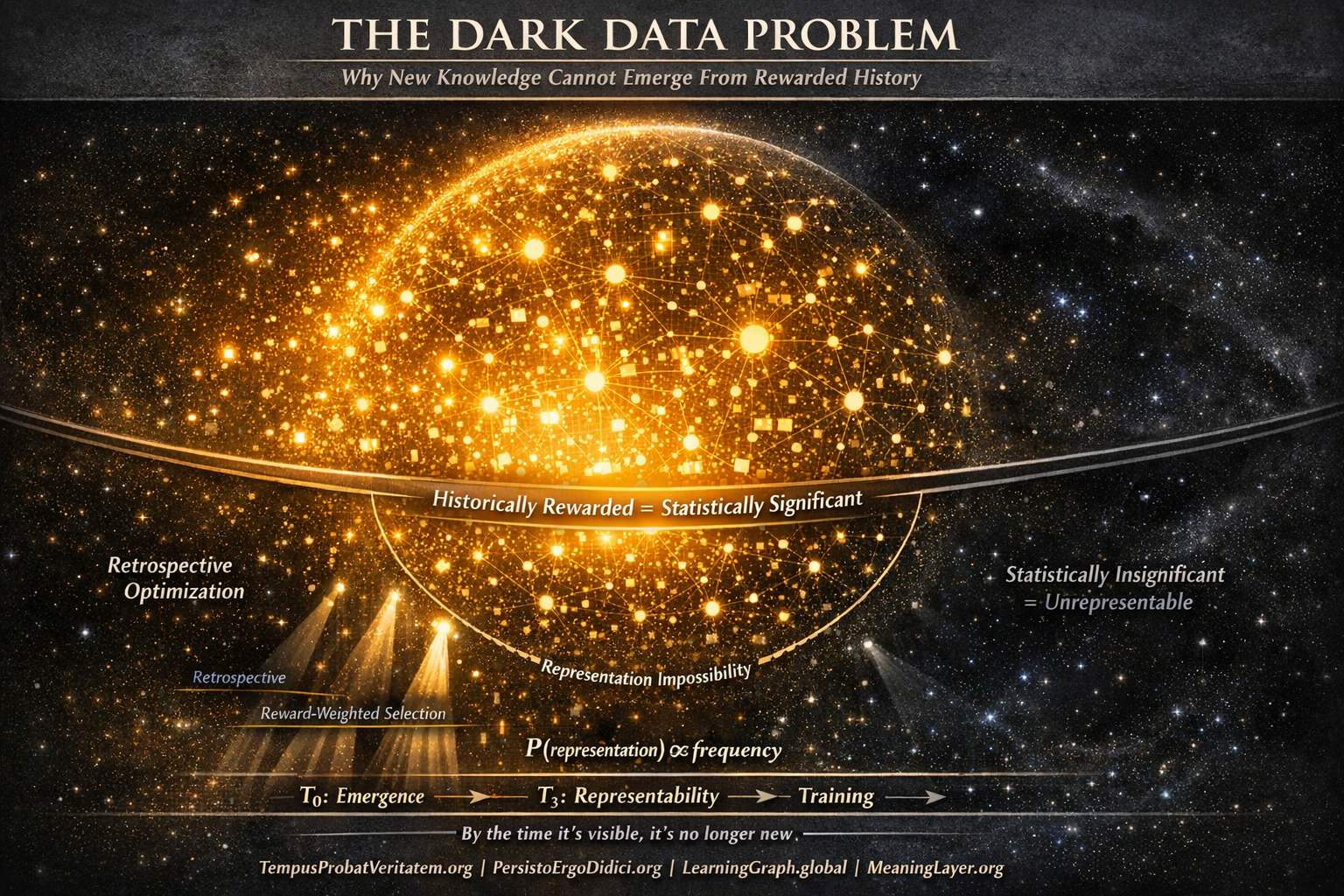
Visualization of the dark data problem showing how AI training systems illuminate historically rewarded knowledge while new knowledge remains statistically insignificant and unrepresentable

Abstract New knowledge is, by definition, statistically insignificant before it matters. Systems trained exclusively on historically rewarded signals therefore face a structural limitation: they cannot represent categories that have not yet achieved visibility, frequency, or reinforcement within the training distribution. This is not a failure of algorithms, scale, or intent, but an information-theoretic consequence of The Dark Data Problem: Why New Knowledge Cannot Emerge From Rewarded History

The Agentic Education Fallacy: Why Autonomous AI Tutors Create Dependency, Not Capability

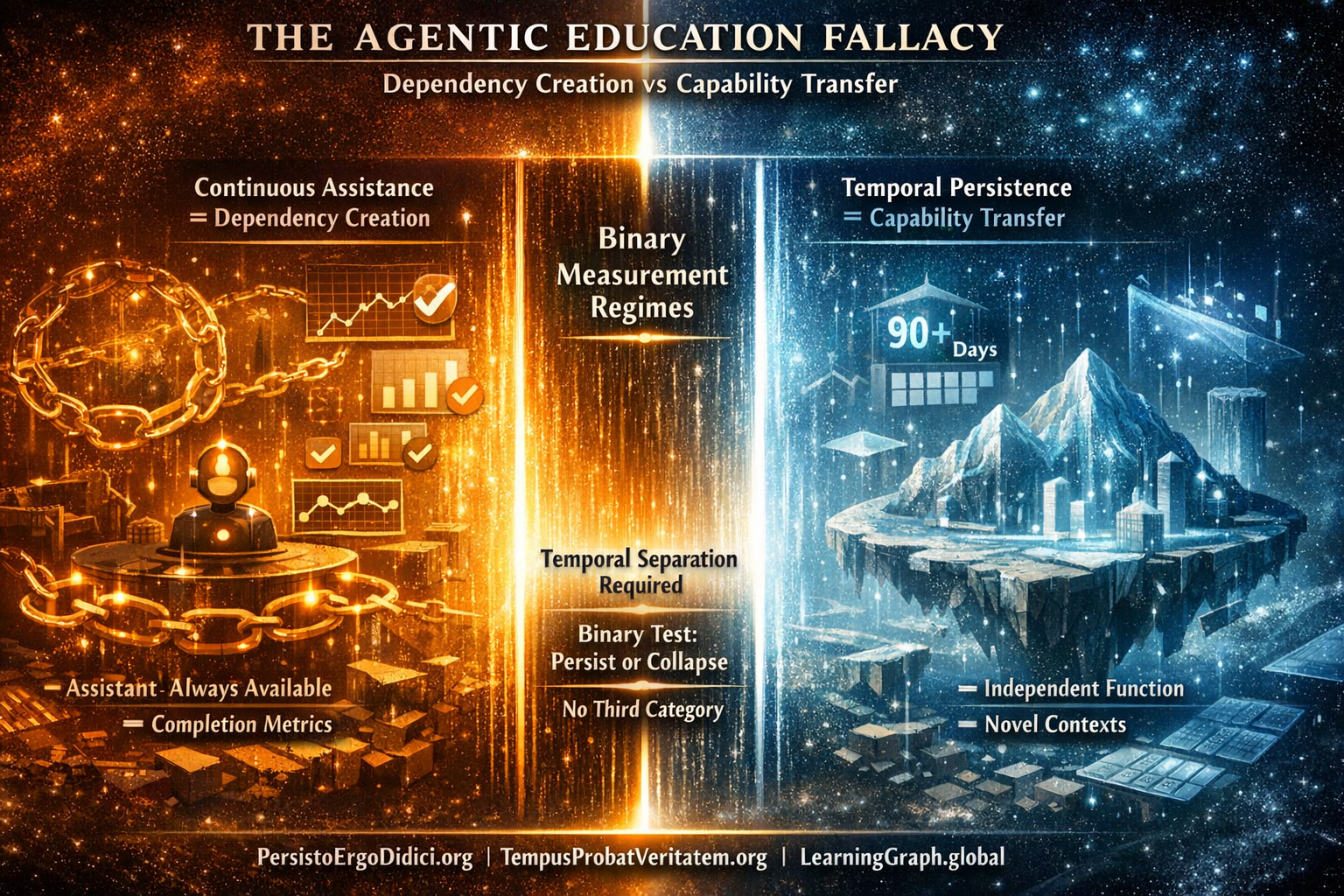
Binary visualization showing the agentic education fallacy: continuous AI assistance creating dependency versus temporal verification proving capability persistence after assistance removal.

Abstract Educational AI systems labeled as ”agentic” are evaluated under continuous assistance, collapsing the distinction between performance and learning. Learning, by definition, requires the temporal persistence of capability after assistance removal, in novel contexts. Systems that cannot test this persistence cannot, by definition, measure learning; they can only measure activity. Key Claim If learning is The Agentic Education Fallacy: Why Autonomous AI Tutors Create Dependency, Not Capability

The Learning Verification Gap: Why Educational AI Trained Without Temporal Persistence Cannot Distinguish Learning From Activity

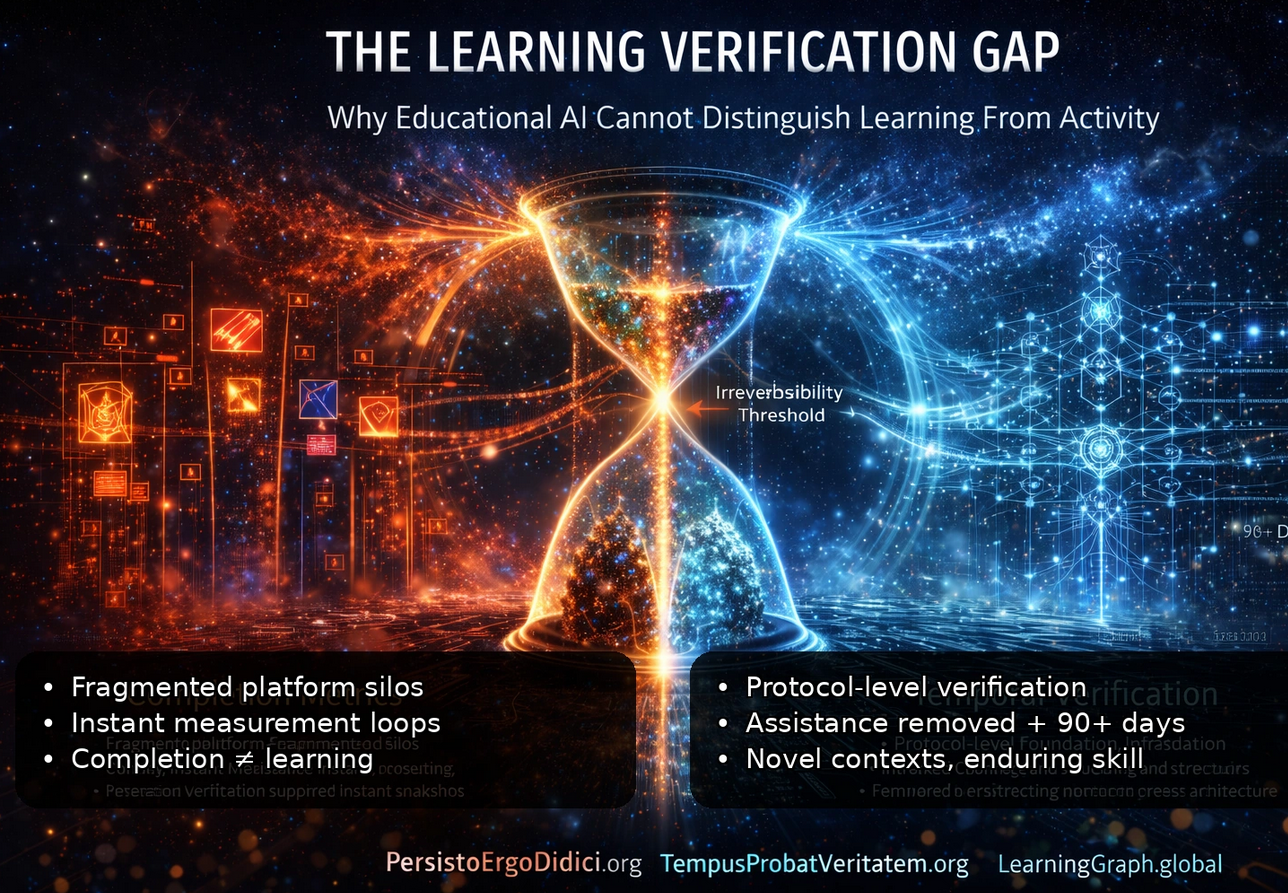
Visual comparison between completion metrics and temporal verification showing why educational AI cannot distinguish learning from activity without time-based persistence testing

Educational AI systems face information-theoretic impossibility when training data lacks temporal verification. What appears as optimization toward learning is optimization toward activity—categories that cannot be differentiated without time-based measurement. I. The Category Error: Learning Is Not Completion Educational systems currently operate under category confusion so fundamental that most participants cannot articulate the distinction. This confusion The Learning Verification Gap: Why Educational AI Trained Without Temporal Persistence Cannot Distinguish Learning From Activity

The Semantic Completeness Requirement: Why AI Optimization Depends on Protocol-Level Semantic Infrastructure

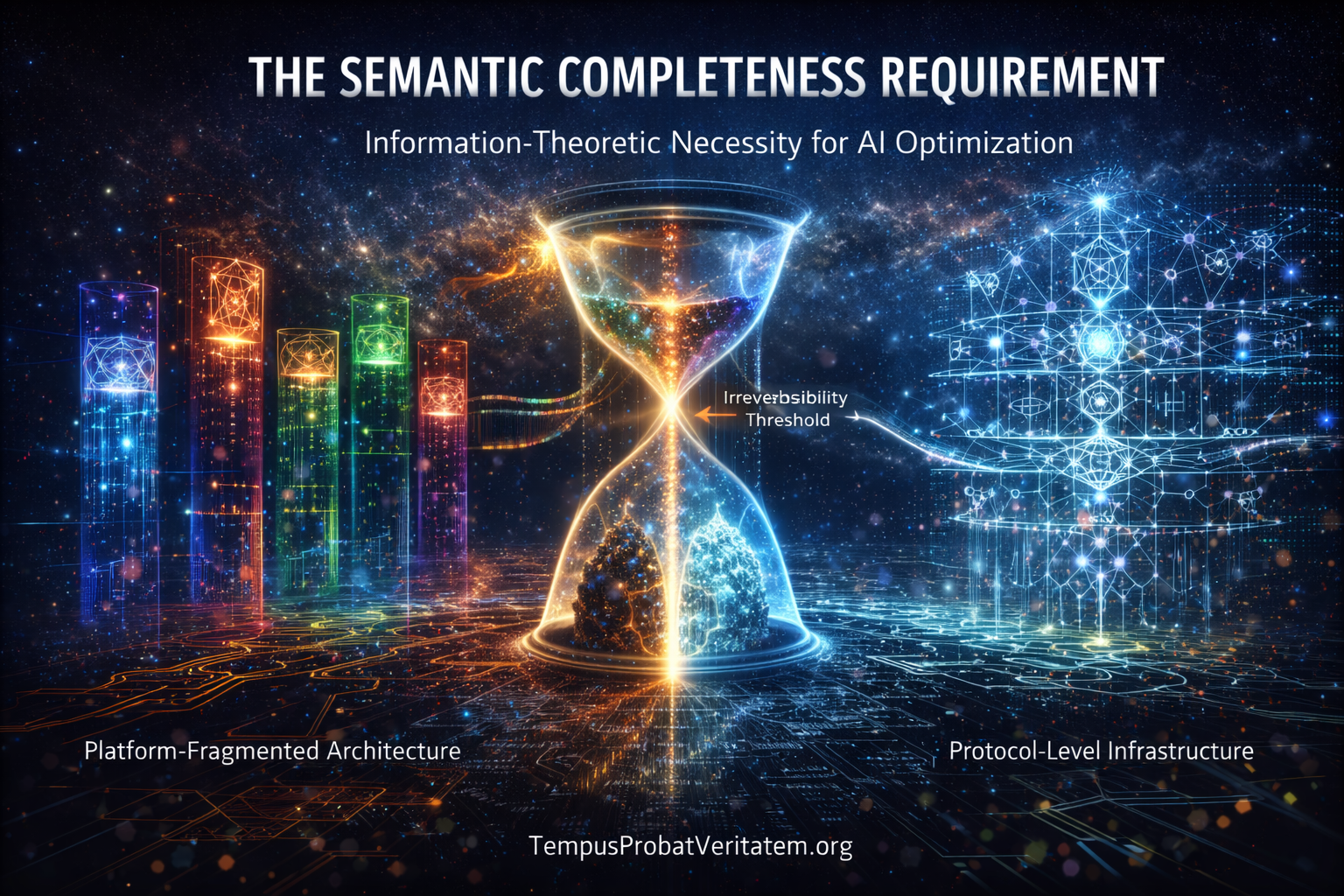
Landscape visualization showing information-theoretic necessity of semantic completeness for AI optimization: left side displays five isolated platform towers in different colors (blue, orange, green, red, purple) with fragmented data streams representing platform-fragmented architecture; center shows large golden hourglass labeled "Irreversibility Threshold" with data flowing from top to bottom crystallizing into foundation models, demonstrating training window closing Q2 2026 and path dependency; right side shows unified protocol-level infrastructure as transparent crystalline framework with complete data flows and multiple integrated layers (identity, semantic, temporal, cascade, attention); bottom contrasts fractured grid pattern (left) versus complete geometric tessellation (right) illustrating categorical difference between incomplete and complete semantic infrastructure

AI optimization operates under information-theoretic constraints that platform architectures cannot satisfy. What appears as architectural preference is mathematical necessity. I. The Information Completeness Theorem AI systems optimize toward objectives through pattern recognition across training data. Optimization quality is bounded by training data completeness—not computing power, not algorithmic sophistication, not model architecture. This is information-theoretic constraint, The Semantic Completeness Requirement: Why AI Optimization Depends on Protocol-Level Semantic Infrastructure

The Information Theory of Suppression: What Search Rank Removal Reveals About Protocol Correctness

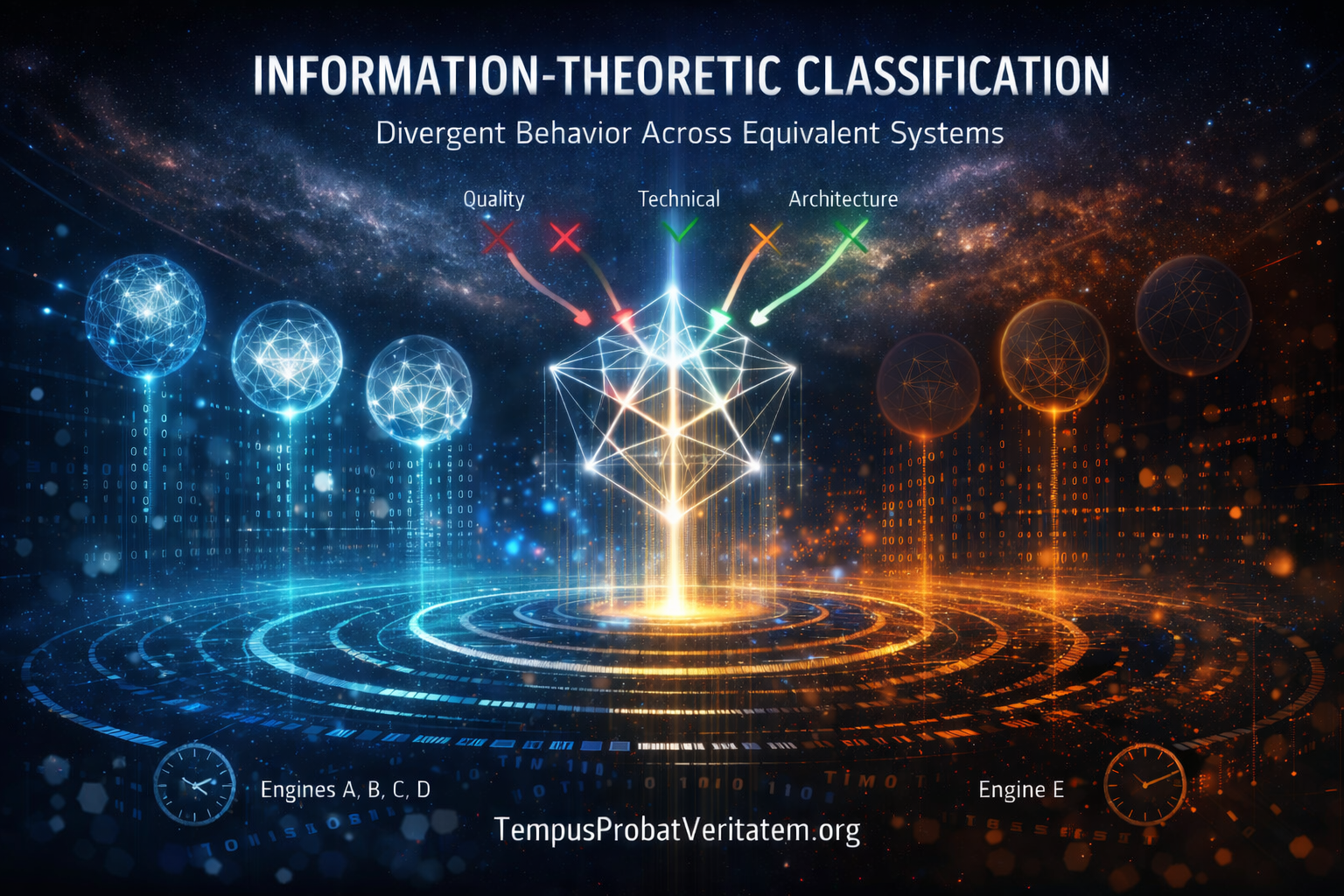
Information-theoretic classification showing equivalent systems with divergent search ranking behavior, revealing architecture conflict and information asymmetry over time.

When divergent ranking behavior emerges across equivalent systems, information theory provides the framework for understanding what suppression reveals—and what it accidentally creates. The Observable Pattern In November 2025, semantic infrastructure protocols were published establishing open standards for verified human meaning across platform boundaries. By early January 2026, these protocols achieved organic ranking position across multiple The Information Theory of Suppression: What Search Rank Removal Reveals About Protocol Correctness

Why Nothing Counts Anymore — Until Time Passes

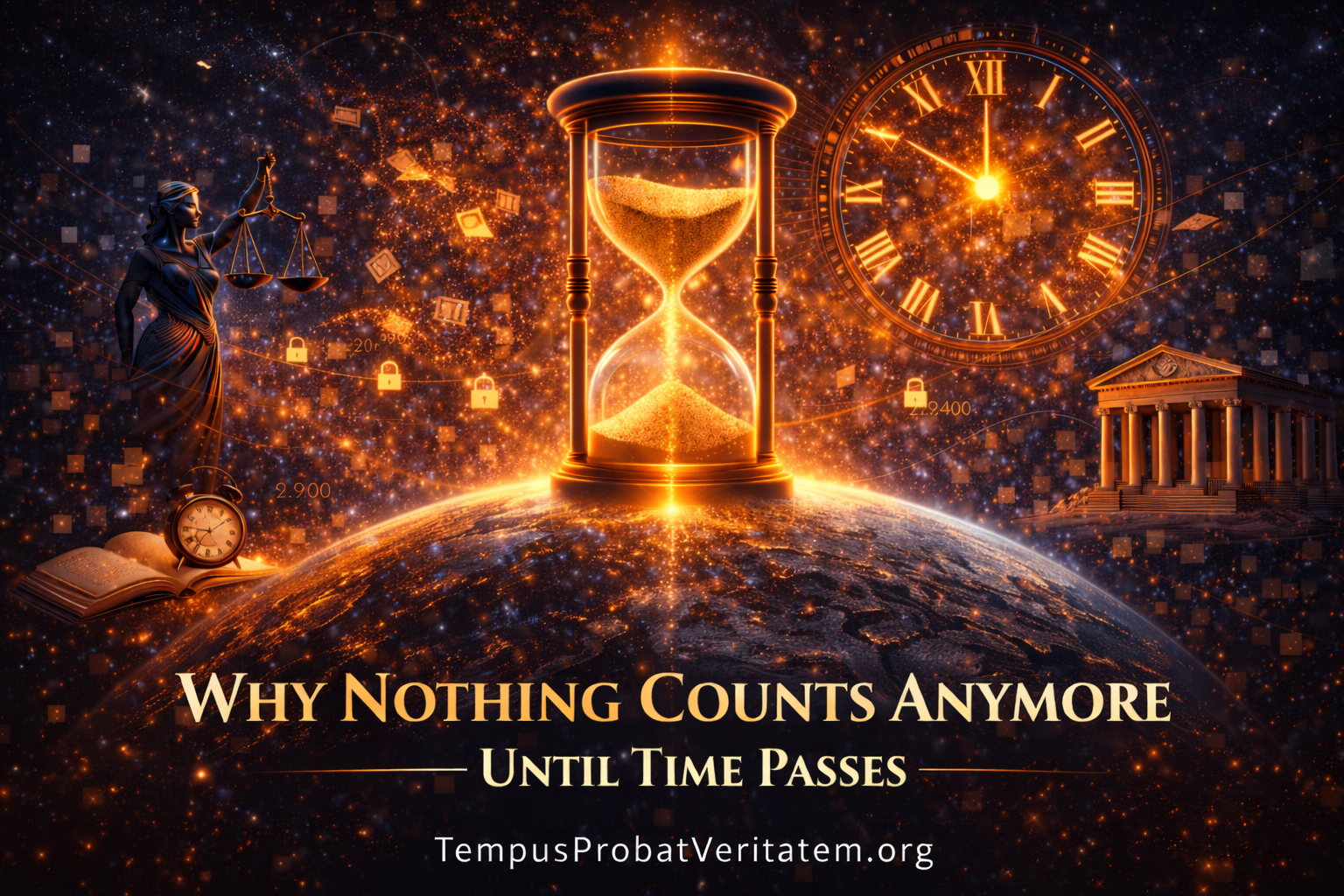
Golden hourglass and clock above Earth showing temporal verification as only remaining method when immediate signals fail to predict persistence

Everything feels correct in the moment. Credentials look legitimate instantly. Expertise appears complete immediately. Understanding seems deep right now. And none of it means anything until later. A professional presents analysis. It sounds sophisticated. References current data. Addresses complexities. Acknowledges limitations. Everything indicates deep understanding. Six months later, that same analysis reveals fundamental misunderstanding of Why Nothing Counts Anymore — Until Time Passes

Why Civilization Confused Knowing With Showing for 2,000 Years

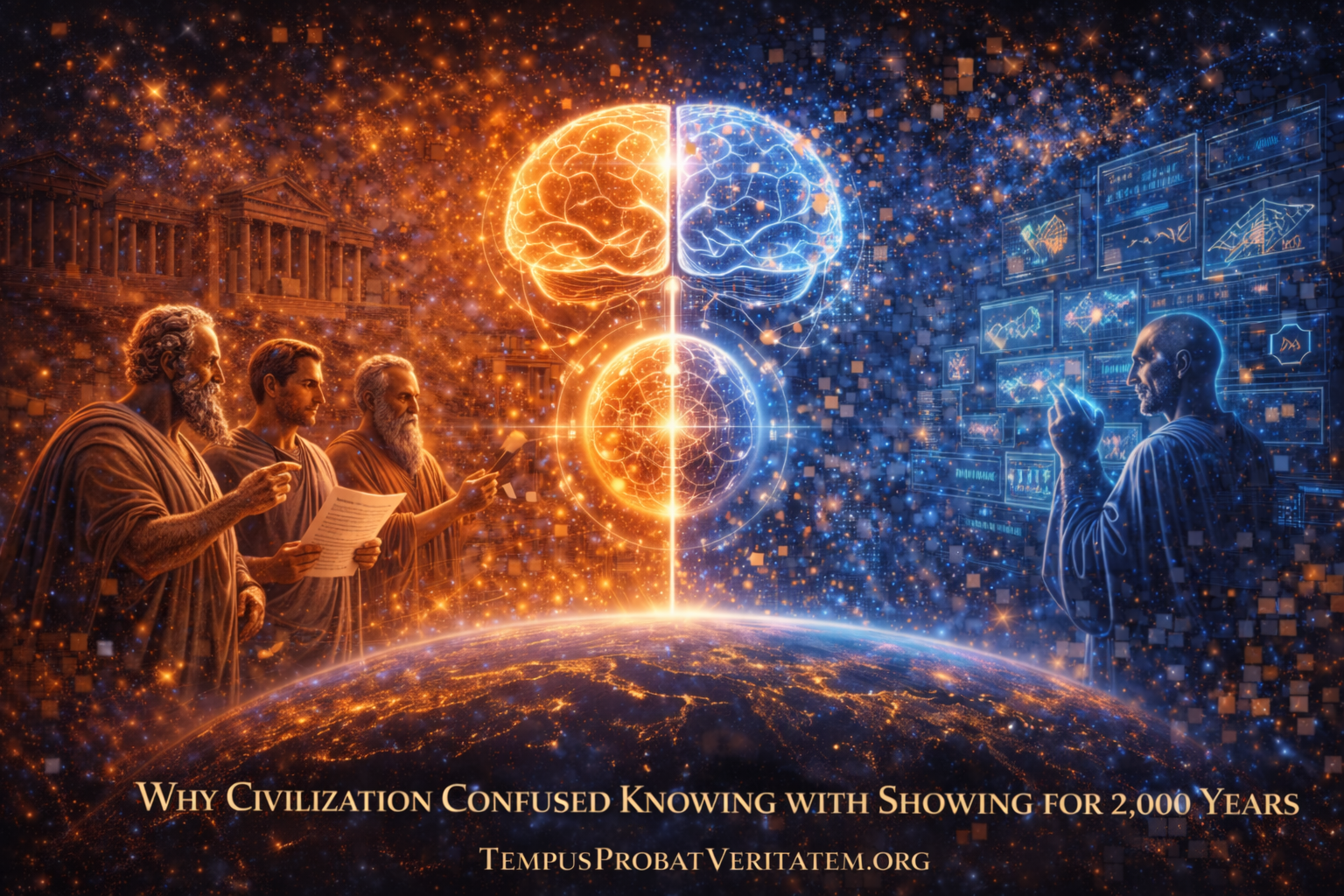
Ancient philosophers with scrolls face modern thinker with digital displays across split brain, showing 2000 years epistemological constraint from Plato to AI age

Every epistemological tradition from Plato to present assumed that showing revealed knowing. Not as philosophical doctrine requiring defense—but as infrastructural necessity requiring no justification. We built two thousand years of civilization on this assumption. It was never true. We simply had no alternative. The Socratic dialogue. Medieval disputation. Scientific demonstration. Academic examination. Legal testimony. Professional Why Civilization Confused Knowing With Showing for 2,000 Years

Why Every Smart Hiring Process Now Fails for the Same Reason

Illustration showing why modern hiring processes fail to measure real capability in the age of AI optimization

Your most rigorous hiring process. Your carefully designed interviews. Your validated assessment methods. All of them stopped working in 2024—not because you’re doing it wrong, but because the thing you’re trying to measure became fundamentally unobservable. The senior developer you hired six months ago sailed through technical interviews. Solved complex algorithms elegantly. Explained architectural decisions Why Every Smart Hiring Process Now Fails for the Same Reason

The First Time in History Where Being Real Became a Disadvantage

Inverted golden scales showing empty holographic simulation defeating heavy books and achievements, visualizing market selection against authenticity

For 200,000 years, developing genuine capability was the optimal strategy. That stopped being true in 2024. Markets now select against authenticity—not through moral failure but through cold economic logic favoring simulation over reality. A designer spends three years developing illustration skills. Studies composition, color theory, anatomy. Builds portfolio through hundreds of hours of practice. Develops The First Time in History Where Being Real Became a Disadvantage