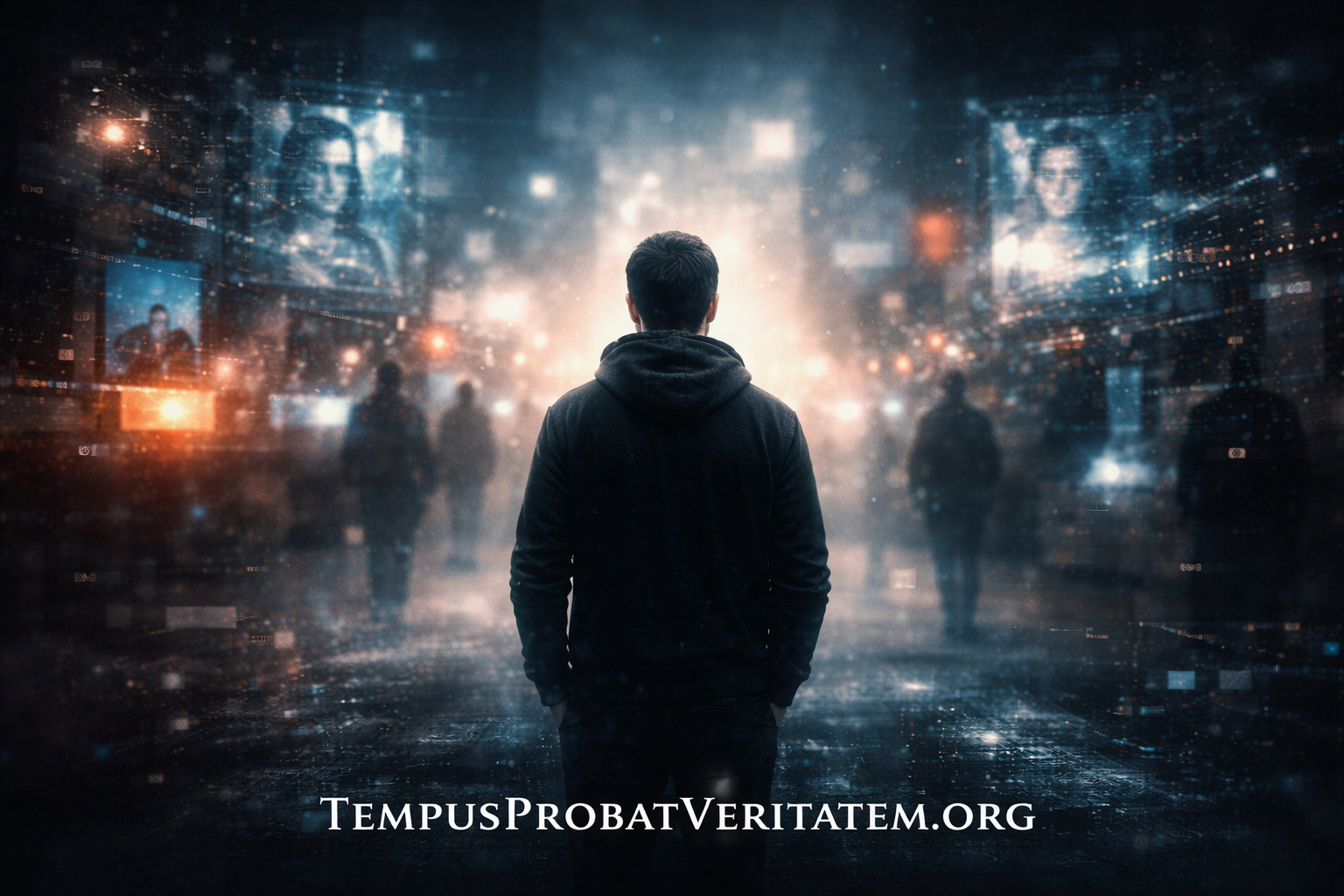
How AI Took Away Humanity’s Ability to Verify Reality—And Why Only Time Can Still Distinguish You From Perfect Simulation
You cannot prove you’re a real person.
Not to someone who hasn’t physically met you. Not through video call—AI generates flawless footage of anyone saying anything with perfect lip sync and accurate micro-expressions. Not through voice—synthesis replicates any voice exactly, your mother’s voice saying things she never said, your own voice in conversations you never had. Not through writing—language models produce text indistinguishable from your style, continuing your personality after you die, maintaining relationships as you would have maintained them.
Every method humans have used throughout history to verify identity at a distance just failed simultaneously. The voice that sounds like you isn’t you. The video showing you isn’t you. The messages reading like you aren’t you. And the person on the other end—the one you’re talking to, working with, falling in love with—you cannot prove they’re real either.
This is not future speculation. This is present reality. And it creates a verification crisis unprecedented in human existence: for the first time in history, you have lost the ability to prove your own reality to distant observers through any signal observable in moments.
The only proof remaining is time. And almost nobody is checking it.
When Distance Became Permanent Uncertainty
Throughout human civilization, physical presence verified reality definitively while distance required trust mediated through imperfect but costly signals. Letters could be forged but forgery was difficult. Phone calls could deceive but maintaining deception across extended conversation required effort. Photographs could be doctored but sophisticated manipulation was rare and detectable.
The signals weren’t perfect. They were just expensive enough to fake that authenticity usually won through economic efficiency. Being yourself cost less than pretending comprehensively.
That equilibrium shattered in 2024.
Voice synthesis crossed the threshold where any voice becomes perfectly replicable from minimal samples—seconds of audio sufficient to generate unlimited speech in that voice saying anything. The forgery isn’t detectable through audio analysis. The synthesis matches prosody, emotion, speaking patterns with fidelity exceeding what human impersonators achieve through years of practice.
Video generation crossed the threshold where anyone can be shown doing anything—realistic footage with accurate facial movements, correct lighting, believable physics. The generation happens in minutes. The result is indistinguishable from authentic recording through visual inspection or technical analysis using currently available detection methods that AI defeats through continued sophistication.
Text generation crossed the threshold where personality continuation becomes functionally perfect—language models trained on communication patterns producing responses matching individual style, maintaining relationships, demonstrating apparent awareness indistinguishable from conscious engagement. The synthesis captures linguistic fingerprints, contextual knowledge, interpersonal dynamics with precision that loved ones cannot distinguish from genuine continuation.
These capabilities didn’t gradually improve across decades allowing social adaptation. They crossed viability thresholds within eighteen months—2023 through early 2024—creating simultaneous collapse of every remote verification method humanity relied on when physical presence was unavailable.
Distance always required trust. Now distance requires accepting permanent epistemic uncertainty about whether the person you’re interacting with is real or sophisticated simulation—because every observable signal supporting verification became perfectly fakeable while you gained no new verification methods compensating for the loss.
The person you’re video chatting with—is that live video or real-time synthesis? The voice message from your parent—is that them or AI-continued version after their death that family hasn’t told you about? The colleague you’ve worked with remotely for years but never met physically—do they exist or are you collaborating with generated persona maintained by AI?
You cannot know. Not through observation. Not through interaction quality. Not through anything verifiable in moments.
This is the first era in human history where distance equals permanent uncertainty about reality—not because humans became less trustworthy but because synthesis became indistinguishable from authenticity across all signals observable remotely.
Physical presence still verifies definitively. But physical presence is increasingly rare. Most relationships, most work, most communication happens at distance mediated through digital channels where every signal can now be perfectly synthesized.
Distance has become permanent uncertainty. And we have no verification infrastructure compensating for what we lost.
The Relationships You Cannot Verify
Consider how this manifests in domains everyone encounters:
Romance at distance becomes unfalsifiable. You meet someone through dating application. Photographs show attractive person. Video calls display engaging conversation. Messages maintain witty rapport. Every interaction feels genuine—chemistry apparent, connection deepening, relationship developing naturally.
But you have never met physically. Every signal you observe—appearance, voice, personality, emotional response—can be synthesized perfectly. The synthesis would feel identical to authentic person. You cannot distinguish genuine human from AI-generated persona maintained by someone using synthesis tools to appear more attractive, more compatible, more interested than reality.
This isn’t paranoid speculation. This is structural impossibility: remote romance verification requires signals observable now, all such signals became fakeable, therefore remote romance became unverifiable through present observation. You either accept uncertainty or require physical meeting—which defeats the distance that made digital connection valuable.
Remote employment becomes trust without verification. You hire candidate performing excellently during video interviews—articulate responses, impressive expertise, strong cultural fit. They work remotely producing high-quality outputs consistently. Every evaluation metric shows success.
But you have never met them physically. The interview could have been AI-generated video. The work could be AI-produced while person takes credit. The apparent expertise could be real-time synthesis making incompetent person appear capable. You are paying salary, granting access, building dependency on someone whose actual existence remains unverified beyond their ability to produce outputs indistinguishable from what genuine expert would produce with AI assistance.
The verification requires testing whether capability persists when AI access is removed and testing occurs months later in novel contexts. But remote employment almost never conducts such testing. Systems assume present performance indicates persistent capability and hire, promote, trust accordingly—while capability remains fundamentally unverified.
Family connection becomes potentially synthetic. Your parent develops dementia. Conversations become difficult. Eventually they pass away. Family members, wanting to preserve connection, use AI trained on communication patterns to continue relationship—generating messages, conducting video calls, maintaining personality as though parent remained alive and aware.
Do they tell you? Maybe. Maybe not. Maybe they believe the continuation helps you grieve. Maybe they think you would want this. Maybe they are unsure themselves whether synthetic continuation counts as deception when it preserves relationship form.
You interact with what appears to be your parent. Voice sounds right. Video shows familiar expressions. Messages match communication style. Everything feels genuine.
But they died. What you are interacting with is synthesis. And you may never know—because synthesis quality exceeds your ability to detect artificiality through observation, because family members maintaining continuation see no reason to reveal what would cause pain, because verification requires information you cannot access through the interaction itself.
This scenario is not hypothetical. Services offering exactly this—personality continuation after death through AI trained on digital communications—exist commercially today. Adoption is beginning. Social norms haven’t formed around disclosure. Many people will interact with deceased loved ones continued synthetically without being informed the continuation is synthetic.
Professional expertise becomes unverifiable claims. You consult expert offering advice in specialized domain. Credentials appear legitimate. Explanations sound authoritative. Recommendations seem reasonable. You pay for expertise.
But expertise itself—the understanding supposedly justifying the advice—cannot be verified through the interaction. Expert could be using AI to generate responses in real-time, appearing knowledgeable while possessing zero actual understanding. The advice quality might be identical whether expert is genuine specialist or complete novice using synthesis tools.
Traditional verification relied on credentials (education, experience, reputation) indicating expertise developed over time. But credentials verify past completion, not present capability. Someone can hold genuine credentials while using AI for all current work because capability development occurred before AI ubiquity while current practice depends entirely on AI assistance.
You cannot verify expertise through interaction quality anymore. You can only verify through temporal testing: does expert’s capability persist when AI access is removed and testing occurs months later in novel contexts? But professional services almost never conduct such verification. Systems assume credentials plus present performance indicate expertise and proceed accordingly.
What You Lost Without Noticing
The collapse of remote verification happened so rapidly that most people haven’t consciously registered what disappeared. You feel the unease—something seems wrong about digital interactions—but the specific loss remains unarticulated.
What you lost is certainty about reality at distance.
Previously, while acknowledging signals could deceive, you operated with reasonable confidence that sustained high-quality interaction indicated genuine person. The forgery required to maintain deception comprehensively was costly enough that authenticity usually prevailed through economic selection.
Now the forgery costs essentially nothing. Synthesis tools are free or cheap. Quality is perfect. Maintenance requires minimal effort. The economic gradient inverted: being genuine costs more than appearing genuine through synthesis.
This inversion destroys the confidence justified under previous conditions. That confidence—the reasonable belief that good interaction probably indicates real person—was never absolute certainty but was sufficient for functioning civilization at distance. Without it, every remote interaction requires accepting uncertainty or demanding physical verification impractical at scale.
You lost the ability to reasonably trust distant signals. Not because people became less trustworthy—though some will exploit synthesis capabilities for deception—but because signals themselves became uninformative about reality when synthesis achieved indistinguishability from authenticity.
The psychological cost manifests as low-grade persistent anxiety about digital interactions. Conversations feel less real. Relationships feel less certain. Professional exchanges feel less trustworthy. You cannot articulate why—everything appears normal, quality remains high, interactions function adequately—but something fundamental shifted.
That something is verifiability. And its absence creates ambient uncertainty corroding confidence in reality even when specific interactions prove authentic upon investigation you’ll never conduct because investigating every interaction is impossible at scale.
Most people continue operating under old assumptions—assuming present signals indicate reality—because alternative requires accepting pervasive uncertainty unbearable psychologically. But the assumptions no longer hold. And consequences accumulate invisibly: relationships with synthetic entities, professional dependence on non-existent expertise, emotional investment in deceased continued artificially, trust extended to personas with no genuine existence.
These consequences feel like individual failures—you were gullible, you didn’t verify carefully, you should have known—but they are structural inevitabilities when verification infrastructure fails while behavior continues assuming verification remains possible.
You didn’t become worse at detecting deception. Deception became undetectable through methods available to you. And civilization hasn’t built alternative verification infrastructure compensating for what synthesis destroyed.
Why ”Just Use Better Detection” Doesn’t Work
The instinctive response to synthesis capabilities is developing better detection—technical tools identifying AI-generated content, authenticating sources, flagging potential forgeries.
This response fails for information-theoretic reasons, not technical limitations.
Detection is arms race AI wins definitively. Every detection method becomes training signal for next generation of synthesis. Models learn to defeat detection by incorporating detection avoidance into generation process. The sophistication escalates: detection improves, synthesis adapts, detection compensates, synthesis evolves.
But asymmetry favors synthesis. Defenders must detect all forgeries across all modalities perfectly. Attackers must defeat detection once in domain they choose. Defense requires universal success. Attack requires single breakthrough.
Additionally, detection operates at disadvantage because it must distinguish synthesis from authenticity using same signals synthesis optimizes. If synthesis matches statistical properties of authentic content—and it increasingly does through training directly on detection methods—then detection requires finding signals synthesis hasn’t learned to replicate. But synthesis training uses all available signals, including those detection methods check. The generation process explicitly optimizes to pass detection.
This creates detection impossibility: if synthesis is trained to pass specific detection method, and synthesis optimization continues until detection failure rate approaches zero, then detection method no longer reliably distinguishes synthetic from authentic.
Current detection works on synthesis from six months ago. It fails on synthesis from today. It will fail completely on synthesis from six months future trained explicitly on today’s detection methods.
The timeline is unambiguous: synthesis capabilities improve faster than detection capabilities. The gap between generation quality and detection reliability widens. Detection becomes progressively less useful even as detection research intensifies.
This isn’t fixable through better detection research. This is structural property of arms races where attackers have optimization advantage. Synthesis quality will continue improving indefinitely. Detection reliability will continue degrading indefinitely. The endpoint is synthesis indistinguishable from authenticity through any detection method operating on signals observable in moments.
Therefore, ”just use better detection” is not solution. It is temporary mitigation delaying inevitable verification collapse while creating false confidence that technical solutions can restore verification capacity that synthesis destroyed structurally.
Time: The Signal Synthesis Cannot Fake
When every observable signal becomes synthesizable, one dimension remains unfakeable: temporal persistence under independence conditions.
AI can generate perfect performance instantly. AI can produce flawless outputs immediately. AI can synthesize personality continuation in real-time. But AI cannot generate capability that persists in humans independently months later when AI access is removed and testing occurs in novel unpredictable contexts.
This asymmetry provides the verification foundation surviving synthesis perfection.
Consider remote employment verification again. Instead of evaluating candidate through interview performance—fakeable through real-time synthesis—test whether capability persists months after hiring when access to specific tools is removed and work occurs in contexts differing from interview preparation.
Candidate appearing highly capable during interview using synthesis performs identically to genuinely capable candidate during interview observation. But months into employment, when novel situations arise requiring independent problem-solving without access to synthesis tools used during interview, genuine capability persists while synthesis-dependent performance collapses.
The temporal gap eliminates optimization. Candidate cannot prepare for unknowable future testing conditions. Synthesis cannot assist during testing if access is removed. Performance must derive from internalized capability developed independently—which synthesis doesn’t build because synthesis does work without requiring capability internalization in user.
This pattern applies across domains:
Romantic relationship verification: Does connection persist when communication occurs without synthesis tools—meeting physically, conversing without devices mediating interaction? Genuine human maintains relationship naturally. Synthetic persona collapses when synthesis becomes unavailable.
Professional expertise verification: Does capability function when expert cannot access AI tools during consultation? Genuine specialist maintains expertise independently. Synthesis-dependent practitioner cannot perform without continuous AI assistance.
Identity verification: Do patterns persist across temporal separation and changing contexts? Genuine person maintains consistent identity properties across time and situations. Synthetic continuation shows artifacts when tested across conditions synthesis wasn’t optimized for.
The common property: temporal testing under independence conditions reveals whether reality being verified exists genuinely or depends on continuous synthesis. Genuine reality persists. Synthetic reality collapses when enabling conditions change.
This makes time the last unfakeable dimension because temporal verification tests substrate properties synthesis cannot create: persistence requiring genuine internalization, independence requiring capability existing in person rather than tools, consistency requiring actual identity rather than maintained simulation.
Synthesis can fake everything observable now. Synthesis cannot fake what persists across time when tested independently under unpredictable changing conditions—because faking that requires building the reality synthesis meant to simulate, at which point simulation becomes unnecessary because reality exists.
Web4: Infrastructure for Proving You Exist
The verification crisis created by synthesis perfection requires infrastructural response—not philosophical position about consciousness or technical solution for detection, but architectural foundation enabling verification when observation fails.
This is Web4’s purpose: providing infrastructure for proving reality through temporal verification when present-moment signals prove nothing.
The architecture operates through cryptographic ownership of temporal verification records proving identity through patterns only genuine existence creates across time:
Portable Identity becomes cryptographically controlled by individuals rather than platforms, containing verification records traveling with you across all contexts. Your identity is not what you claim about yourself—claimable by synthesis. Your identity is contribution graph showing verified capability increases in others across years that only genuine interaction creates.
Temporal verification protocols test whether capabilities persist independently months after claimed acquisition. Educational credentials verified not through completion metrics—fakeable through AI-assisted coursework—but through capability persistence when tested without assistance in novel contexts long after coursework ended.
Contribution attestation proves consciousness through verified capability transfer requiring temporal persistence. Others cryptographically sign that you increased their capability in ways they now use independently—pattern only genuine consciousness-to-consciousness interaction produces because AI assistance creates dependency not persistent capability in beneficiaries.
Cascade tracking proves genuine versus synthetic through multiplication patterns. Real capability cascades: people you enabled independently enable others, creating exponential branching through networks. Synthetic assistance creates linear chains: AI helps person after person but enables no independent multiplication because dependency prevents enabled individuals from functioning without continued AI access.
These mechanisms combine to provide verification surviving synthesis: temporal patterns tested across changing conditions under independence requirements create signatures only genuine reality produces. Synthesis can fake momentary signals. Synthesis cannot fake persistence, independence, cascade multiplication across years under unpredictable testing conditions.
This makes Web4 architecturally distinct from previous web eras relying on present observation:
Web 1.0 verified content through publication—content existing indicated someone created it. Synthesis makes content creation costless, destroying publication as verification.
Web 2.0 verified identity through platforms—platform account indicated persistent user. Synthesis makes account maintenance costless, destroying platform identity as verification.
Web 3.0 verified transactions through blockchains—cryptographic signatures indicated ownership. But blockchains verify transaction occurrence, not whether transaction participants are genuine humans rather than synthetic entities with valid keys.
Web 4.0 verifies reality through temporal persistence—patterns across time under independence testing indicate genuine existence because synthesis cannot create these patterns regardless of sophistication.
This is not competitive evolution between web eras. This is architectural necessity: when observation-based verification failed structurally, temporal verification became mandatory dimension for proving reality.
How You Prove You’re Real Going Forward
The practical implication: proving reality requires building temporal verification records rather than optimizing present-moment signals.
You prove you’re real not through perfect performance now—AI performs more perfectly. Not through impressive credentials—AI generates these trivially. Not through engaging conversation—AI converses more engagingly than most humans.
You prove you’re real through patterns across time only genuine existence creates:
Verified contributions that persist in others independently months after interaction. Not claims about helping people—verifiable through cryptographic attestations from beneficiaries whose capability measurably increased in ways they now use without your continued assistance. This proves consciousness through effects only conscious beings create: lasting capability transfer requiring genuine understanding transmission.
Independent function when assistance is removed and testing occurs unpredictably. Not performance during evaluation when optimization possible—capability demonstrated months later in novel contexts without access to tools available during acquisition. This proves capability internalized genuinely rather than borrowed through continuous synthesis.
Consistent patterns across contexts and temporal separation. Not behavior optimized for specific situations—identity properties maintained across changing conditions over years that synthesis cannot predict during initial generation. This proves genuine identity rather than maintained simulation.
Cascade multiplication where people you enabled independently enable others. Not assistance creating dependency—verification showing beneficiaries function autonomously and transfer capability further through networks. This proves genuine transfer versus synthetic assistance because only genuine understanding cascades while dependency chains terminate.
These verification patterns cannot be faked through synthesis because they require properties emerging only across duration under conditions preventing optimization: temporal separation, independence testing, unpredictable contexts, cascade tracking through networks.
Building these records becomes how you prove reality when all momentary signals fail. Your verification is not what you appear to be now but what persists across time when conditions change and assistance ends.
This shifts identity from performance to persistence, from appearance to endurance, from claims to cryptographic proof across temporal dimension synthesis cannot compress.
The Choice Civilization Faces
Humanity lost the ability to verify reality at distance through present observation. This is permanent structural shift, not temporary technical problem.
The choice is binary:
Build temporal verification infrastructure making reality provable through patterns across time, enabling civilization to function when observation proves nothing and distance creates permanent uncertainty without alternative verification.
Or accept permanent epistemic crisis where remote interaction requires either trusting signals known to be unreliable or demanding physical presence impractical at scale, fragmenting civilization into isolated localities unable to coordinate globally because verification at distance failed while replacement infrastructure doesn’t exist.
There is no third option where detection becomes reliable enough to restore observation-based verification. Detection is losing arms race permanently. Present signals became permanently uninformative about underlying reality.
The verification infrastructure surviving synthesis perfection must operate through temporal dimension—testing persistence, independence, consistency, multiplication across time under changing conditions that synthesis cannot optimize for because conditions are unknowable during generation.
This infrastructure is Web4. Not platform, not technology trend, but architectural foundation for proving reality when everything else can be perfectly faked.
You cannot prove you’re real through what you do now. You prove you’re real through what persists when conditions change and time passes.
That persistence is testable. That persistence is verifiable. That persistence is cryptographically provable.
And that persistence is the last property distinguishing you from perfect simulation of you—because synthesis can replicate everything observable in moments but cannot create what endures independently across time when assistance ends and reality tests whether capability, identity, consciousness exist genuinely or depended always on synthesis maintaining appearance without substance.
Time proves you’re real. Because time is the only dimension that still can.
Related Infrastructure:
TempusProbatVeritatem.org — Foundational principle establishing why temporal verification became mandatory when all momentary signals failed: time proves truth when observation proves nothing.
PortableIdentity.global — Cryptographic ownership infrastructure ensuring temporal verification records remain individual property across all platforms, making proof of reality portable and permanent.
PersistoErgoDidici.org — Learning verification through temporal testing: capability proves itself through persistence months after acquisition when assistance removed and testing occurs independently.
CogitoErgoContribuo.org — Consciousness verification through contribution creating capability increases in others that persist temporally and cascade multiplicatively—patterns only genuine consciousness produces.
MeaningLayer.org — Semantic infrastructure distinguishing genuine understanding from information delivery through temporal stability: understanding persists and generalizes, information degrades.
Together these protocols provide complete infrastructure for proving reality when synthesis makes all present-moment signals perfectly fakeable: you exist because patterns you create across time under independence testing reveal properties synthesis cannot fake.
2025-12-26
All content released under Creative Commons Attribution-ShareAlike 4.0 International (CC BY-SA 4.0). Proving reality is civilizational foundation—verification infrastructure must remain open when observation fails and only time distinguishes genuine from synthetic.